
Trigonalidae
Genus Guides
3is a of parasitic constituting the sole living members of the superfamily Trigonaloidea. With over 90 described in 16 , these wasps exhibit a remarkably complex involving hyperparasitism. Females deposit thousands of minute on or within leaves, which must be consumed by a caterpillar to initiate development. The family is divided into two : Orthogonalinae (containing only Orthogonalys) and Trigonalinae. Trigonalidae has been proposed as the sister group to all .
Pronunciation
How to pronounce Trigonalidae: /traɪˌɡoʊnəˈlaɪdiː/
These audio files are automatically generated. While they are not always 100% accurate, they are a good starting point.
Identification
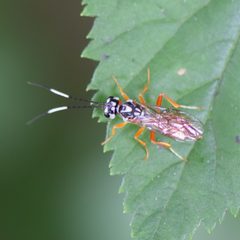
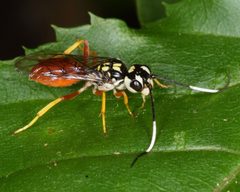
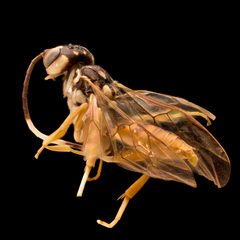
can be distinguished from other hymenopteran by several morphological features. Members of the Trigonalinae possess antennal tyloids (sensory structures on the ), which are absent in Orthogonalinae. Trigonalinae females typically possess metasomal armature, though this has been secondarily lost in some lineages. The tribe Trigonalini is characterized by elongate parameres and an intertorulus distance approximately equal to the distance between the torulus and the . Orthogonalys, the sole of Orthogonalinae, retains many generalized apocritan characters and lacks the specialized trigonalid features found in Trigonalinae.
Images
Habitat
has been recorded from both dry forest and rainforest . are associated with environments where their complex relationships can be sustained, including areas with abundant lepidopteran larvae and vespid .
Distribution
is known from all parts of the world. The has been recorded from North America (including the Eocene Okanagan Highlands fossil site), Central America ( Rica), South America, Europe (Fennoscandia, Baltic states), Asia (India, Vietnam, China, Taiwan, Myanmar), and presumably other regions given their global distribution.
Diet
Larvae are or hyperparasitoids. They develop by feeding on other parasitoid larvae present within caterpillars, or on vespid larvae after the caterpillar has been captured and fed to them. A few exceptional directly parasitize larvae.
Host Associations
- Lepidoptera larvae (caterpillars) - primary ( ingestion) must be consumed by caterpillar; larva then attacks other within or waits for secondary
- Vespidae larvae - secondary Trigonalid larva attacks larva after caterpillar is killed and fed to it
- Ichneumonidae larvae - of hyperparasitismPseudogonalos hahnii hyperparasitizes lepidopteran larvae via ichneumonid primary
- Eulophidae larvae - competitor/preyTrigonalid larvae attack other larvae including siblings within caterpillar
- Symphyta larvae (sawflies) - primary A few exceptional directly parasitize without intermediate
Life Cycle
Females deposit thousands of minute on leaf edges or inject them inside leaves. Eggs must be consumed by a caterpillar to continue development. Once ingested, the egg hatches and the larva either immediately attacks other larvae present in the caterpillar (including sibling trigonalids), or remains until the caterpillar is captured by a vespid and fed to its larva. The trigonalid larva then attacks the wasp larva. If the caterpillar is neither parasitized by another wasp nor fed to a vespid, development fails.
Behavior
Females exhibit specialized oviposition , depositing in large quantities (thousands) on or within leaf tissue. The involves a facultative hyperparasitoid strategy with potential sibling . Some trigonalid larvae can delay development for extended periods, waiting for the secondary (vespid larva) to become available.
Ecological Role
functions as a hyperparasitoid in , potentially regulating of primary and influencing the of both lepidopteran herbivores and vespid . Their complex creates unusual trophic linkages between plant tissue, caterpillars, parasitoids, and social .
Human Relevance
has minimal direct economic importance due to extreme rarity and complex . The is of scientific interest for understanding the evolution of and potential phylogenetic relationships to . Some have been studied in the context of research, though their practical application is limited by their specialized requirements.
Similar Taxa
- Evanioidea has sometimes been hypothesized to be related to Evanioidea within , though current placement in separate superfamily Trigonaloidea reflects distinct morphological and biological differences
- IchneumonidaeBoth are , but differs fundamentally in -laying on vegetation rather than direct attack, and in the requirement for egg ingestion by host
- BraconidaeBoth are of caterpillars, but exhibits the unique hyperparasitoid strategy involving leaf- deposition and potential secondary through vespid
Misconceptions
The name has been misspelled as 'Trigonalyidae' and 'Trigonaloidae' by some authors; these spellings are unjustified emendations and incorrect under Article 29.5 of the ICZN. Social paper wasps were traditionally considered only secondary , but evidence suggests they may sometimes serve as primary hosts.
More Details
Fossil Record
The fossil record is poor. No confirmed members prior to the Cenozoic. The oldest confirmed fossils are from the Ypresian Eocene Okanagan Highlands in western North America. A possible specimen from mid-Cretaceous Burmese amber differs substantially from modern members and may represent a stem-group. The extinct Maimetshidae from the Cretaceous has been suggested as a relative within Trigonaloidea.
Phylogenetic Position
is possibly the sister group to all (stinging , ants, and bees), though its phylogenetic position within has been considered indeterminate.
Taxonomic Revision
A 1998 phylogenetic revision synonymized several under Taeniogonalos and Trigonalys, and established the tribe Nomadinini based on secondary loss of tyloids, comprising previous Seminotinae, Nomadininae, Bareogonalinae, and Lycogastrinae.
Sources and further reading
- BugGuide
- Wikipedia
- GBIF taxonomy match
- iNaturalist taxon
- NCBI Taxonomy
- Catalogue of Life
- Inventory on the family Trigonalidae (Insecta: Hymenoptera)
- Phylogenetic revision of the parasitoid wasp family Trigonalidae (Hymenoptera)
- Biological Notes on the Parasitism of Apoica flavissima Van der Vecht (Hymenoptera: Vespidae) by Seminota marginata (Westwood) (Hymenoptera: Trigonalidae): Are Social Paper Wasps Primary or Secundary Hosts of Trigonalidae?
- Occurrence and biology of Pseudogonalos hahnii (Spinola, 1840) (Hymenoptera: Trigonalidae) in Fennoscandia and the Baltic states
- FIRST RECORD OF THE GENUS LYCOGASTER (HYMENOPTERA: TRIGONALIDAE) FROM VIETNAM, WITH NOTES ON THE VARIABILITY AND BIOLOGY OF L. FLAVONIGRATA
- Description of a new species of Taeniogonalos Schulz (Hymenoptera: Trigonalidae) from South India with an updated key to Indian species
- First Report of the Hyperparasitoid Taeniogonalos gundlachii Cresson (Hymenoptera: Trigonalidae) from Hyalophora cecropia L. (Lepidoptera: Saturniidae)
- Hyperparasitoid wasps (Hymenoptera, Trigonalidae) reared from dry forest and rain forest caterpillars of Area de Conservación Guanacaste, Costa Rica
- Occurrence of the parasitoid Seminota marginata (Westwood, 1874) (Hymenoptera: Trigonalidae) in a nest of the social wasp, Apoica (Apoica) flavissima (Van der Vecht, 1973) (Hymenoptera: Vespidae)
- Figure 23 from: Smith D, Janzen D, Hallwachs W, Smith M (2012) Hyperparasitoid wasps (Hymenoptera, Trigonalidae) reared from dry forest and rain forest caterpillars of Area de Conservación Guanacaste, Costa Rica. Journal of Hymenoptera Research 29: 119-144. https://doi.org/10.3897/jhr.29.3233
- Figure 3 from: Smith D, Janzen D, Hallwachs W, Smith M (2012) Hyperparasitoid wasps (Hymenoptera, Trigonalidae) reared from dry forest and rain forest caterpillars of Area de Conservación Guanacaste, Costa Rica. Journal of Hymenoptera Research 29: 119-144. https://doi.org/10.3897/jhr.29.3233
- Über Pseudogonalos hahn Spin. (Hym. Trigonalidae) und seine Wirte: Untersuchungen über die Entwicklung von Parasiten bei Coleophora laricella Hbn. mit Hilfe von Röntgenphotographie
- Figures 21–22 from: Smith D, Janzen D, Hallwachs W, Smith M (2012) Hyperparasitoid wasps (Hymenoptera, Trigonalidae) reared from dry forest and rain forest caterpillars of Area de Conservación Guanacaste, Costa Rica. Journal of Hymenoptera Research 29: 119-144. https://doi.org/10.3897/jhr.29.3233
- DNA Barcoding of Central European Gasteruptiidae and the rarely-collected families Evaniidae, Stephanidae, Trigonalidae, and Aulacidae (Hymenoptera, Apocrita).