
Chyphotinae
Genus Guides
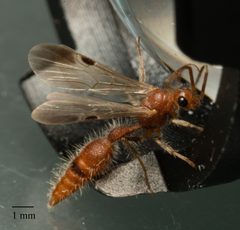
1Chyphotinae is a of within the Chyphotidae, a group of small, wasps in the order Hymenoptera. Members of this subfamily are among the least studied chyphotid wasps, with most known from few specimens. They are distinguished from the other chyphotid subfamily, Chyphotinae's sister group, by subtle morphological features of the and mesosoma. The group appears to be primarily distributed in arid and semi-arid regions of the Americas.
Pronunciation
How to pronounce Chyphotinae: /kɪˈfoʊtɪneɪ/
These audio files are automatically generated. While they are not always 100% accurate, they are a good starting point.
Identification
Chyphotinae can be distinguished from the Chyphotinae (now often treated as the other subfamily within Chyphotidae, sometimes referred to as the 'other chyphotid lineage') by the following features: with two or more teeth (as opposed to simple or falcate mandibles), and specific arrangements of setae on the and . The subfamily also tends to show reduced wing venation compared to some related groups, with forewings lacking enclosed beyond the basal .
Images
Habitat
Arid and semi-arid environments including desert scrub, dry grasslands, and sandy areas. Specimens are frequently collected in association with soil or ground-level vegetation, suggesting ground-nesting or ground-foraging habits.
Distribution
Primarily distributed in the Nearctic and Neotropical regions, with records from the southwestern United States through Mexico and into Central and South America. The shows a center of diversity in the arid zones of western North America and northern Mexico.
Seasonality
have been collected primarily during spring and summer months in temperate regions, with activity likely extending into early fall in warmer areas. Specific phenological data are sparse for most .
Behavior
Members are presumed to be based on -level characteristics, though specific records for Chyphotinae are extremely limited. have been observed running on the ground and low vegetation, suggesting they may search for hosts in soil or litter.
Ecological Role
As putative , members likely contribute to of unknown organisms, possibly other insects or arthropods in soil or ground-dwelling .
Similar Taxa
- Chyphotinae (other subfamily of Chyphotidae)The two of Chyphotidae are morphologically similar and were historically confused; separation requires examination of mandibular , clypeal setation, and wing venation patterns.