
Dolerus
Jurine, 1807
Species Guides
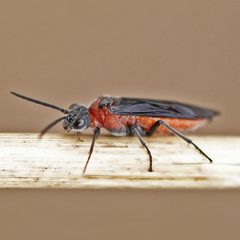
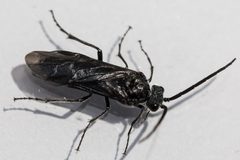
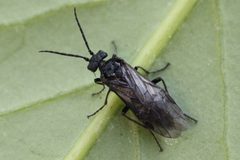
13Dolerus is a of in the Tenthredinidae, Selandriinae. occur in Europe and North America. Larvae of multiple species have been documented feeding on Equisetum (horsetails) and grasses, with some species showing specialized associations. The genus includes several subgenera, notably Equidolerus and Achaetoprion, which have been subject to recent taxonomic revision.
Pronunciation
How to pronounce Dolerus: /dɔˈlɛrʊs/
These audio files are automatically generated. While they are not always 100% accurate, they are a good starting point.
Identification
Larvae can be distinguished from Lepidoptera caterpillars by having six or more pairs of (Lepidoptera have five or fewer). Larvae of the subgenus Achaetoprion can be identified using morphological keys based on last feeding stage characteristics. of certain groups can be differentiated by imaginal diagnostic characters, particularly within the subgenus Equidolerus.
Images
Habitat
are associated with moist supporting their plants. Six Nearctic species (D. aprilis, D. tibialis conjugatus, D. gilvipes albifrons, D. apricus, D. acidus, D. subfasciatus) have been reared from field horsetail (Equisetum arvense) in the Ottawa region. Two Nearctic species (D. sericeus, D. nitens) inhabit grasslands. Dolerus (Achaetoprion) pachycerus has been found in Poland in association with rush habitats.
Distribution
Europe and North America. Specific records include: Nearctic region (United States, Canada including Ottawa region, Vermont); Palaearctic region (Poland, Sweden, Denmark).
Seasonality
periods vary by within the subgenus Achaetoprion; specific timing documented for Polish species.
Diet
Larval diet includes: Equisetum arvense (field horsetail) for six Nearctic ; grasses for D. sericeus and D. nitens; Juncus compressus (a rush) for D. (Achaetoprion) pachycerus in Poland.
Host Associations
- Equisetum arvense - larval food plantfield horsetail; six Nearctic
- Poaceae - larval food plantgrasses; D. sericeus and D. nitens
- Juncus compressus - larval food plantround-fruited rush; D. pachycerus
Life Cycle
described for Nearctic ; larvae feed externally on plants. Mature larvae of D. tritici exhibit specialized ultramorphological adaptations for a tilted- feeding strategy on host plants.
Behavior
Larvae feed externally on plants rather than mining or boring. D. tritici larvae employ a distinctive tilted- feeding posture facilitated by structural adaptations.
Similar Taxa
- Lepidoptera caterpillars larvae resemble caterpillars but have six or more pairs of versus five or fewer in Lepidoptera
- Other Tenthredinidae larvaeDolerus larvae specifically associated with Equisetum and grasses; other often have different plant associations
More Details
Subgeneric classification
The includes subgenera Equidolerus and Achaetoprion. Recent taxonomic work has revised limits within Equidolerus, validating D. subfasciatus F. Smith 1874 and recognizing D. neoaprilis, D. pseudoanticus, and D. rhodogaster as distinct species.
Larval morphology
Dolerus haematodes larvae have been illustrated as an example of larvae with prominent , serving as a diagnostic comparison against Lepidoptera.
Sources and further reading
- BugGuide
- Wikipedia
- GBIF taxonomy match
- iNaturalist taxon
- NCBI Taxonomy
- Catalogue of Life
- Dolerus haematodes sawfly larva and Schinia oleagina larva - Entomology Today
- Catch a Glimpse of Caterpillars During National Moth Week
- Materials to the knowledge of Polish sawflies. The genus Dolerus Panzer, 1801 (Hymenoptera, Symphyta, Tenthredinidae, Selandriinae). Part XVIII Dolerus (Achaetoprion) pachycerus Hartig, 1837 with observations on its biology and a key for identification of larvae of subgenus Achaetoprion Goulet, 1986
- Taxonomy of Dolerus subfasciatus auct. and D. subfasciatus F. Smith with notes on the sawfly subgenus Equidolerus (Hymenoptera, Tenthredinidae)
- DESCRIPTIONS OF LARVAE OF EIGHT NEARCTIC SPECIES OF DOLERUS (HYMENOPTERA: TENTHREDINIDAE) WITH FOCUS ON SIX EQUISETUM- FEEDING SPECIES FROM THE OTTAWA REGION
- The tilted-head feeding strategy: ultramorphological adaptations of the mature larvae of Dolerus tritici (Hymenoptera: Tenthredinidae) to feeding on their host plants