
Selandriinae
Tribe Guides
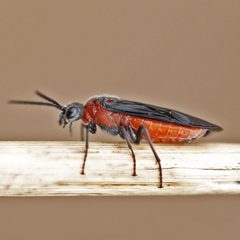
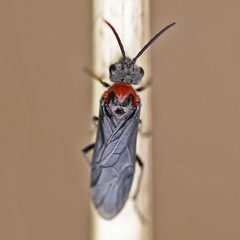
4Selandriinae is a of within Tenthredinidae, characterized by diverse larval feeding habits including both external and internal plant feeding. The subfamily includes economically notable groups such as Dolerini, which contains over 70 Nearctic primarily associated with rushes and sedges, and Heptamelini, whose larvae develop in fern tissues. Members exhibit considerable morphological diversity and have been subject to extensive taxonomic revision due to complex species-level relationships.
Pronunciation
How to pronounce Selandriinae: /sɛlænˈdaɪɪniː/
These audio files are automatically generated. While they are not always 100% accurate, they are a good starting point.
Identification
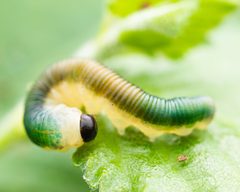
Selandriinae can be distinguished from other Tenthredinidae by combinations of structural characters including features of the , , and ovipositor; specific diagnostic characters vary by tribe and require reference to specialized keys. Dolerini are recognized by characteristic pronotal and abdominal structures used in subgeneric classification. Heptamelini are distinguished by reduced wing venation and association with fern . Larvae of different tribes exhibit distinct morphologies: endophytic Heptamelus larvae are adapted for boring in fern petioles, while exophytic larvae such as Pseudoheptamelus have external feeding adaptations.
Images
Habitat
Members occupy diverse tied to plant availability. Dolerini are associated with wetlands and moist grasslands where rushes (Juncus) and sedges occur. Heptamelini are restricted to fern habitats, including both natural woodlands and cultivated settings where ferns are grown. Specific microhabitats include fern petioles for endophytic larvae and frond surfaces for exophytic feeders.
Distribution
Nearctic and Palearctic regions with documented occurrence in North America, Europe, and Asia. Nearctic Dolerini are extensively documented across Canada and the United States with type localities spanning Ontario, British Columbia, Oregon, California, Washington, Idaho, Pennsylvania, Northwest Territories, Quebec, New Brunswick, Nevada, and Alaska. European Heptamelini occur in Western and Central Europe, with Heptamelus dahlbomi introduced to North America.
Seasonality
periods vary by and region. For Dolerus subgenus Achaetoprion, flight periods have been documented and graphically presented for Polish species, showing distinct temporal patterns among sympatric species. Specific timing depends on latitude and local climate conditions.
Diet
Larvae feed on plant tissues with tribe-specific patterns. Dolerini larvae feed on rushes and sedges; Dolerus (Achaetoprion) pachycerus larvae have been observed feeding on Juncus compressus. Heptamelini larvae feed on ferns: Heptamelus are endophytic in fern petioles, while Pseudoheptamelus runari feeds exophytically on Athyrium filix-femina rachis and dead pinnae tissue.
Host Associations
Life Cycle
Holometabolous development with larval stages adapted to specific feeding habits. Larvae of some groups are endophytic, developing within plant tissues, while others feed externally. Complete occurs with in soil or plant debris. Larval identification keys exist for some groups based on morphological characters of last feeding stages.
Behavior
Sexual has been documented for at least one (Leseha vespa), indicating mating behavior study within the . Heptamelus larvae exhibit endophytic boring behavior in fern petioles. Pseudoheptamelus runari larvae show specialized feeding behavior favoring rachis and dead tissue of pinnae over healthy frond tissue.
Ecological Role
Herbivores on monocotyledonous and fern ; contribute to plant tissue processing in wetland and woodland . Some function as pests on cultivated ferns. Larval feeding modes (endophytic versus exophytic) create distinct and damage patterns on host plants.
Human Relevance
Some are minor pests on cultivated ferns, particularly Heptamelus dahlbomi which is more frequent than on cultivated ferns. The has been subject to extensive taxonomic research due to agricultural and horticultural interest in fern-feeding species.
Similar Taxa
- Other Tenthredinidae subfamiliesdistinguished by structural characters of , , and ovipositor; Selandriinae often associated with monocots and ferns rather than woody dicots
- Symphyta outside TenthredinidaeSelandriinae lacks the constricted waist of ; wing venation and larval leg number differ from other
Sources and further reading
- BugGuide
- iNaturalist taxon
- NCBI Taxonomy
- Taxonomy and biology of European Heptamelini (Hymenoptera, Tenthredinidae, Selandriinae)
- Sexual behavior of Leseha vespa Smith & Nishida, 2019 (Hymenoptera, Tenthredinidae, Selandriinae)
- The Genera and Species of the Nearctic Dolerini (Symphyta: Tenthredinidae: Selandriinae): Classification and Phylogeny
- Materials to the knowledge of Polish sawflies. The genus Dolerus Panzer, 1801 (Hymenoptera, Symphyta, Tenthredinidae, Selandriinae). Part XVIII Dolerus (Achaetoprion) pachycerus Hartig, 1837 with observations on its biology and a key for identification of larvae of subgenus Achaetoprion Goulet, 1986