
Euura ribesii
(Scopoli, 1763)
Imported Currantworm
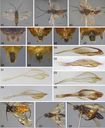
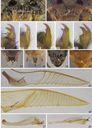
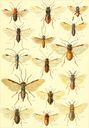
Euura ribesii is a in the Tenthredinidae, commonly known as the Imported Currantworm. It is a significant pest of currant and gooseberry plants (Ribes species), with larvae that feed gregariously on foliage. The species has been introduced to North America from Europe and is now established in multiple regions. are small, -like insects that lack the narrow waist characteristic of many other Hymenoptera.
Pronunciation
How to pronounce Euura ribesii: /ˈjuː.ɜː raɪˈbiːzi.aɪ/
These audio files are automatically generated. While they are not always 100% accurate, they are a good starting point.
Identification
are distinguished from similar by the combination of black body with yellow legs and the specific wing venation pattern. Larvae are identified by their green color with black lateral spots, the number of (6-8 pairs), and their exclusive association with Ribes plants. They can be distinguished from Lepidoptera caterpillars by having more than five pairs of prolegs and from other sawfly larvae by the lateral spotting pattern and host specificity. Similar include Euura americanus and other Nematinae, which often differ in coloration or host plant.
Images
Habitat
Found in gardens, orchards, and wild areas where currant and gooseberry plants (Ribes ) grow. Requires moist soil conditions for larval development and . Thrives in temperate regions with adequate plant availability.
Distribution
Native to Europe; introduced and established in North America. Documented present in Belgium (including Brussels-Capital and Flemish Regions), Iceland, and Norway. Widespread in northern and central Europe and across much of northern North America.
Seasonality
emerge in spring, typically April to June depending on latitude. Larvae are present from late spring through early summer. One to two per year in most regions, with partial second generations in warmer areas. Overwinters as in soil cocoons.
Diet
Larvae feed exclusively on leaves of currant and gooseberry (Ribes ), including black currant, red currant, and gooseberry. They skeletonize leaves, consuming tissue between . do not feed.
Host Associations
- Ribes nigrum - larval food plantblack currant
- Ribes rubrum - larval food plantred currant
- Ribes uva-crispa - larval food plantgooseberry
- Ribes - larval food plant level
Life Cycle
Holometabolous with complete . are inserted into leaf tissue by females. Larvae hatch and feed gregariously on foliage, passing through several instars. When mature, larvae drop to the ground and spin silken cocoons in the soil to pupate. Most individuals overwinter as in cocoons, with emerging the following spring. Some individuals may complete a second in favorable conditions.
Behavior
Larvae feed gregariously, often defoliating entire leaves while leaving the intact. When disturbed, larvae may raise their end and regurgitate fluid as a defense. are active during daylight and mate soon after . Females use their saw-like ovipositor to insert into leaf margins.
Ecological Role
Primary consumer that functions as a herbivore on Ribes . Larval feeding can cause significant defoliation, potentially reducing plant and fruit production. Serves as prey for various including birds, predatory , and ground beetles. wasps and flies attack larvae and pupae.
Human Relevance
Major agricultural pest of currant and gooseberry crops. Larval defoliation reduces fruit yield and can kill young plants. Control methods include hand-picking larvae, application of , and using . The 'Imported Currantworm' reflects its non-native status in North America.
Similar Taxa
- Euura americanusSimilar appearance and , but native to North America and often with slightly different coloration in ; historically confused but now distinguished by geographic origin and subtle morphological differences
- Pristiphora appendiculataAnother Ribes-feeding , but larvae lack the black lateral spots and have different abdominal coloration
- Lepidoptera caterpillarsLarvae superficially similar but have five or fewer pairs of with (hooked spines), whereas larvae have six or more pairs without crochets
More Details
Taxonomic History
Long treated under the Nematus, this was transferred to Euura based on phylogenetic studies. The synonym Nematus ribesii is still encountered in older literature.
Invasion History
Introduced to North America in the 19th century, likely via imported Ribes plants. Now more abundant than the native Euura americanus in many areas.