Setabara histrionica
(MacGillivray, 1909)
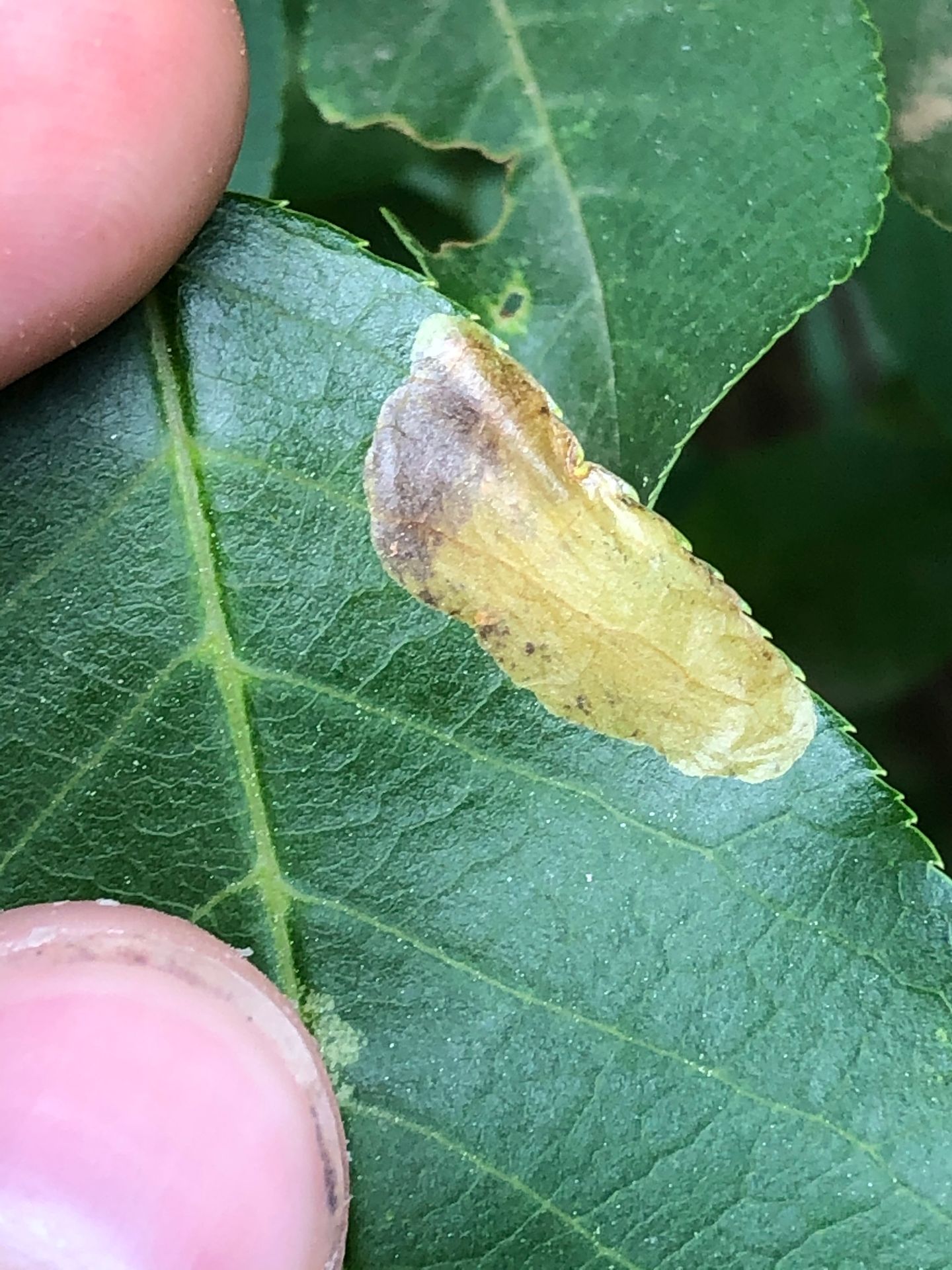
Setabara histrionica is a North leaf-mining in the . First described by MacGillivray in 1909, this was previously known only from collections until its stages and association were described in 2022. The species creates internal leaf mines in bitter cherry (Prunus emarginata) and exhibits specific site preferences on lower foliage.
Pronunciation
How to pronounce Setabara histrionica: //ˌsɛ.təˈbɑː.rə ˌhɪs.triˈɒn.ɪ.kə//
These audio files are automatically generated. While they are not always 100% accurate, they are a good starting point.
Identification
can be distinguished from other Heterarthrinae by morphological features detailed in taxonomic . create blotch- leaf mines in Prunus leaves and can be identified using the updated larval key to Heterarthrinae in Smith (1971), as revised by Baine et al. (2022).
Images
Habitat
Associated with bitter cherry trees (Prunus emarginata) in Washington state. occurs preferentially on leaves growing within 1 meter of the ground, suggesting a preference for lower or understory foliage.
Distribution
North America; documented in Washington state, with additional records from British Columbia and Manitoba, Canada.
Diet
feed internally on leaf tissue of Prunus emarginata, creating leaf mines. Feeding occurs within the leaf mesophyll between upper and lower .
Host Associations
- Prunus emarginata - larval Confirmed in Washington state; previously hypothesized to feed on Prunus
Life Cycle
, larval, and stages described. Females eggs on leaf margins of the third of leaves. develop through multiple as , feeding internally before emerging. Complete documented but specific seasonal timing varies by region.
Behavior
Exhibits precise site selection: most deposited on the margin of the third of the leaf, and on leaves growing within 1 meter of the ground. are .
Ecological Role
and on Prunus trees. Contributes to natural pressure in forest and riparian where plants occur.
Similar Taxa
- Other Heterarthrinae sawfliesSimilar leaf-mining habit and associations with Betulaceae and Rosaceae; distinguished by larval and mine characteristics per Smith (1971)
More Details
Taxonomic history
was previously known only from collections; stages and definitive association remained unknown until 2022 study using combined morphological and molecular (COI barcode) analysis
Research significance
First description of stages resolved long-standing hypothesis about relationships in the Setabara
Sources and further reading
- BugGuide
- GBIF taxonomy match
- iNaturalist taxon
- NCBI Taxonomy
- Meloidae Holdings | Entomology Research Museum
- Harlequin hijinks - Harlequin bug, Murgantia histrionica — Bug of the Week
- Harlequin hijinks: Harlequin bug, Murgantia histrionica — Bug of the Week
- Bugs in Orange and Black, Part 1: Nightmare for collards when harlequin bugs arrive - Murgantia histrionica — Bug of the Week
- Bug Eric: Harlequin Bug
- Harlequin Bug Coloration Influenced by Temperature During Nymphal Stages
- Host plant and immature stages of Setabara histrionica (MacGillivray) (Hymenoptera, Tenthredinidae)
- Figure 1 from: Baine Q, Smith DR, Zakopyko B, Dickerson S, Looney C (2022) Host plant and immature stages of Setabara histrionica (MacGillivray) (Hymenoptera, Tenthredinidae). Journal of Hymenoptera Research 94: 1-11. https://doi.org/10.3897/jhr.94.93555
- Figure 4 from: Baine Q, Smith DR, Zakopyko B, Dickerson S, Looney C (2022) Host plant and immature stages of Setabara histrionica (MacGillivray) (Hymenoptera, Tenthredinidae). Journal of Hymenoptera Research 94: 1-11. https://doi.org/10.3897/jhr.94.93555
- Figure 3 from: Baine Q, Smith DR, Zakopyko B, Dickerson S, Looney C (2022) Host plant and immature stages of Setabara histrionica (MacGillivray) (Hymenoptera, Tenthredinidae). Journal of Hymenoptera Research 94: 1-11. https://doi.org/10.3897/jhr.94.93555
- Figure 2 from: Baine Q, Smith DR, Zakopyko B, Dickerson S, Looney C (2022) Host plant and immature stages of Setabara histrionica (MacGillivray) (Hymenoptera, Tenthredinidae). Journal of Hymenoptera Research 94: 1-11. https://doi.org/10.3897/jhr.94.93555
- Figure 6 from: Baine Q, Smith DR, Zakopyko B, Dickerson S, Looney C (2022) Host plant and immature stages of Setabara histrionica (MacGillivray) (Hymenoptera, Tenthredinidae). Journal of Hymenoptera Research 94: 1-11. https://doi.org/10.3897/jhr.94.93555
- Figure 5 from: Baine Q, Smith DR, Zakopyko B, Dickerson S, Looney C (2022) Host plant and immature stages of Setabara histrionica (MacGillivray) (Hymenoptera, Tenthredinidae). Journal of Hymenoptera Research 94: 1-11. https://doi.org/10.3897/jhr.94.93555