
Tethida barda
(Say, 1836)
Black-headed Ash Sawfly
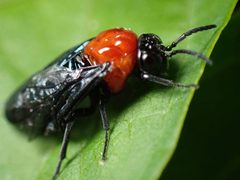
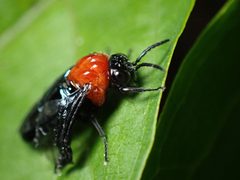
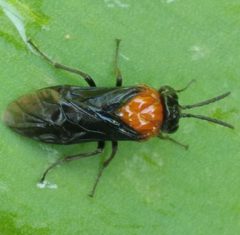
Tethida barda is a in the Tenthredinidae, commonly known as the Black-headed Ash Sawfly. The species is associated with ash trees (Fraxinus species) as a plant. It is found across eastern and central Canada and the northeastern United States. The larvae feed on ash foliage and can occasionally cause noticeable defoliation.
Pronunciation
How to pronounce Tethida barda: //ˈtɛt.hɪ.də ˈbɑːr.də//
These audio files are automatically generated. While they are not always 100% accurate, they are a good starting point.
Identification
The "Black-headed Ash " refers to a dark contrasting with a lighter body, though specific diagnostic features for field identification are not well documented in available sources. As a member of Tenthredinidae, it lacks the constricted " waist" (petiole) characteristic of many other Hymenoptera. Association with ash plants provides a contextual clue for identification.
Images
Habitat
Associated with ash trees (Fraxinus ), indicating woodland, forest edge, and urban or suburban environments where ash is present.
Distribution
Recorded from eastern and central Canadian provinces: Manitoba, New Brunswick, Nova Scotia, and Ontario. The range extends into the northeastern United States based on plant distribution, though specific US state records are not confirmed in the provided sources.
Diet
Larvae feed on ash (Fraxinus) foliage. do not feed; they rely on fat reserves accumulated during the larval stage.
Host Associations
- Fraxinus - larval plantAsh trees; specific Fraxinus not documented in available sources
Ecological Role
Herbivore; larval feeding on ash contributes to nutrient cycling through defoliation and subsequent leaf litter. Serves as prey for and other natural enemies, though specific associations are not documented.
Human Relevance
Can be a minor pest of ornamental ash trees when larval are high, causing defoliation. Not known to be economically significant in forestry contexts.
Similar Taxa
- Other Tethida species may share ash associations; specific distinguishing characters require examination of morphological details not covered in general sources.
- Other ash-feeding sawfliesSeveral Tenthredinidae larvae feed on Fraxinus; accurate identification to typically requires specimens and reference to taxonomic keys.
More Details
Taxonomic note
The was described by Thomas Say in 1836. The Tethida is small and primarily Nearctic in distribution.