
Urocerus flavicornis
Fabricius, 1781
Yellow-horned Horntail, Yellow-horned Horntail Wasp
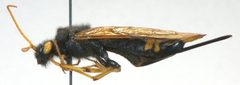
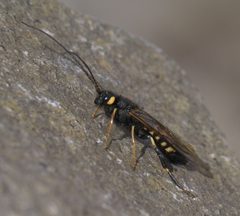
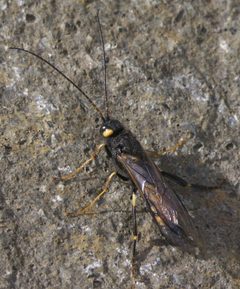
Urocerus flavicornis is a large wood-boring in the Siricidae, commonly known as the yellow-horned horntail. Native to North America, this develops inside dead or dying hardwood trees. are active primarily in late summer and fall. The species is non-venomous and poses no threat to humans despite its intimidating appearance.
Pronunciation
How to pronounce Urocerus flavicornis: //ˌjʊəroʊˈsɪərəs ˌflævɪˈkɔrˌnɪs//
These audio files are automatically generated. While they are not always 100% accurate, they are a good starting point.
Identification
Urocerus flavicornis can be distinguished from the similar Tremex columba (Pigeon Tremex) by its yellow —Tremex columba has dark or black antennae. Both sexes possess a short spine called the cornus at the abdominal tip, giving the its . Females are larger (37–50 mm) than males (18–37 mm) and possess an elongated, drill-like ovipositor that can exceed body length. The body is cylindrical and cigar-shaped, with the broadly joined to the .
Images
Habitat
Found in forests and woodlands with dead, dying, or weakened hardwood trees. are often observed resting on foliage at level. The requires standing dead timber or recently felled trees for oviposition and larval development.
Distribution
Native to North America. Distribution records from GBIF include Canada: Alberta, British Columbia, Labrador, and Manitoba. iNaturalist documents 902 observations, indicating broad distribution across northern and western North America.
Seasonality
emerge primarily in late summer and fall. This timing coincides with the seasonal availability of suitable trees and fungal conditions necessary for larval development.
Life Cycle
Females deposit into dead or dying hardwood trees using a sawtoothed ovipositor that drills through bark and wood. During oviposition, females inoculate the egg site with the wood-rotting fungus Cerrena unicolor, carried in specialized abdominal glands called mycangia. The fungus breaks down cellulose, which larvae then consume along with the decayed wood. Larvae are -like and retain the cornus at the abdominal tip. Development typically requires more than one year. occurs within the wood, with emerging through exit holes.
Behavior
are docile and can be approached closely. Males are frequently observed resting quietly on foliage. Females actively search for suitable trees and may probe inappropriate substrates such as concrete or screens when confused. Adults do not visit flowers; feeding habits of adults remain unknown but may include tree sap from wounds.
Ecological Role
Urocerus flavicornis accelerates wood decomposition by introducing decay fungi into dead and dying hardwoods. The serves as prey for including giant ichneumons (Megarhyssa spp.) and ibaliid wasps (Ibalia spp.), which locate horntail larvae by drilling through wood.
Human Relevance
Non-venomous and harmless to humans despite intimidating size and appearance. The ovipositor is frequently mistaken for a stinger. Not a pest of healthy trees; exploits only trees already damaged by stress, , or other insects. Occasionally encountered by homeowners when emerge from firewood. No control measures are recommended.
Similar Taxa
- Tremex columbaSimilar size, shape, and ; distinguished by dark (U. flavicornis has yellow antennae) and different geographic distribution patterns
- Urocerus californicusOccurs in western North America including Pacific Northwest; U. flavicornis is distinguished by antennal coloration and more northern distribution