
Pygodasis quadrimaculata
Large Four-spotted Scoliid Wasp
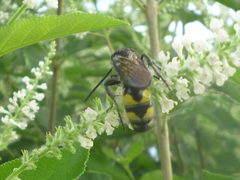
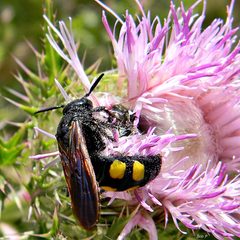
Pygodasis quadrimaculata, commonly known as the Large Four-spotted Scoliid , is a of scoliid wasp in the Scoliidae. Scoliid wasps are solitary, ground-nesting wasps that parasitize scarab beetle larvae. This species is notable for its large size among scoliids and its distinctive four-spotted wing pattern. The species has been documented in 1,712 observations on iNaturalist, indicating it is relatively well-observed and likely not rare in its range.
Pronunciation
How to pronounce Pygodasis quadrimaculata: //ˌpaɪɡoʊˈdeɪsɪs ˌkwɑːdrɪˌmækjʊˈleɪtə//
These audio files are automatically generated. While they are not always 100% accurate, they are a good starting point.
Identification
Distinguished from other scoliid wasps by the four-spotted wing pattern combined with large body size. The Pygodasis is separated from related scoliid genera by morphological features of the wing venation and body structure. Similar in the Scoliidae may share general body form but differ in wing pattern, size, or coloration. The specific epithet 'quadrimaculata' directly refers to the four-spotted diagnostic character.
Images
Appearance
A large scoliid with distinctive four dark spots on the wings. The body is robust and typically dark-colored with possible metallic or hairy characteristics typical of the . Wing venation shows the characteristic four-spotted pattern that gives the its specific epithet. may be present, with females generally larger and possessing a stinger for subduing prey.
Habitat
Associated with sandy or loose soil where scarab beetle larvae occur, as scoliid wasps require access to soil for nesting and location. Typical habitats include open areas, grasslands, and possibly forest edges where scarab larvae are abundant in the soil.
Distribution
Distribution details are not explicitly documented in available sources, but the has been observed and documented across a range sufficient to accumulate 1,712 iNaturalist observations, suggesting a reasonably broad distribution in suitable .
Seasonality
activity likely coincides with the availability of scarab beetle larvae as and favorable weather conditions for . Most scoliid wasps are active during warm months, but specific seasonal patterns for this are not documented.
Behavior
As with other scoliid wasps, females are solitary ground-nesters that hunt scarab beetle larvae. The female locates a scarab larva in the soil, stings it to paralyze it, and lays an on the immobilized . The wasp larva then feeds on the paralyzed scarab larva. Males are typically not involved in nesting or provisioning.
Ecological Role
Acts as a agent of scarab beetles, which can be agricultural or horticultural pests. By parasitizing scarab larvae, this helps regulate scarab in natural and managed .
Human Relevance
Beneficial to agriculture and horticulture due to its role in controlling scarab beetle pests. The sting is used primarily for prey capture and defense; while capable of stinging humans if handled, scoliid wasps are generally not aggressive and do not defend nests communally. The is well-documented by citizen scientists on iNaturalist, contributing to public engagement with entomology.
Similar Taxa
- Other Pygodasis speciesShare -level characteristics of wing venation and body form, but differ in specific wing patterns, size, or coloration
- Other Scoliidae genera (e.g., Scolia, Campsomeris)Share -level traits of robust body, ground-nesting , and scarab , but differ in wing pattern, body proportions, and specific associations
More Details
Taxonomic Note
The Pygodasis is part of the diverse scoliid , which contains approximately 300 worldwide. The family is characterized by solitary, ground-nesting and of scarab beetle larvae.
Citizen Science Documentation
With 1,712 observations recorded on iNaturalist, this represents one of the more frequently documented scoliid wasps, providing valuable distributional and phenological data through science efforts.