
Dielis trifasciata nassauensis
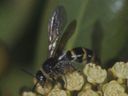
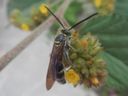
Dielis trifasciata nassauensis is a of scoliid in the Scoliidae. Scoliid wasps are large-bodied wasps whose larvae develop as parasitoids of scarab beetle . The Dielis has been inferred to be non-monophyletic in phylogenetic studies using ultraconserved element data. This subspecies is part of a group whose has historically been unstable and is currently under revision based on modern systematic approaches.
Pronunciation
How to pronounce Dielis trifasciata nassauensis: /ˈdiːlɪs traɪfæsiˈeɪtə næˈsaʊɛnsɪs/
These audio files are automatically generated. While they are not always 100% accurate, they are a good starting point.
Images
Distribution
The epithet "nassauensis" suggests an association with Nassau, likely referring to a geographic location such as Nassau in the Bahamas or a similarly named locality. However, specific distribution records for this subspecies are not documented in the provided sources.
Ecological Role
As a member of Scoliidae, this likely functions as a of scarab beetle larvae (), contributing to natural of scarab . This ecological role is characteristic of the , though specific records for this are not available.
More Details
Taxonomic Note
The Dielis was inferred to be non-monophyletic in a 2022 phylogenetic study by Khouri using ultraconserved element data. The higher-level of Scoliidae is currently in need of revision, and taxonomic changes are recommended to be predicated on expanded geographic and taxonomic sampling.
Research Context
Modern systematic treatment of scoliid wasps has been limited by lack of reliable . Recent work at UC Davis by Ziad Khouri has brought taxonomic order to this using modern and classical techniques combined with - data.
Sources and further reading
- BugGuide
- iNaturalist taxon
- Ziad Khouri: Zeroing in on Mammoth Wasps, the Scoliid Wasps | Bug Squad
- Halloween ID challenge answer – Argiope trifasciata | Beetles In The Bush
- Bug Eric: Spider Sunday: Banded Argiope
- How a Colorado Extension Entomologist Wrangles Pests and Protects Biodiversity
- A truly disturbed garden spider | Beetles In The Bush
- Tiger Beetles at Florida’s “Road to Nowhere” | Beetles In The Bush