
Sapyga louisi
Krombein, 1938
Louis's Club-horned Cuckoo Wasp, club-horned cuckoo wasp
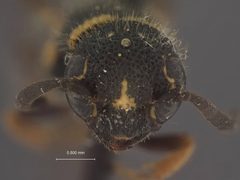
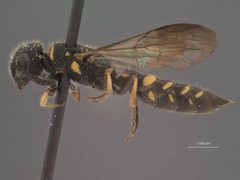
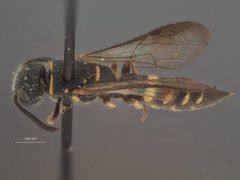
A small of club-horned in the Sapygidae. visit flowers for nectar. The larvae are kleptoparasites that develop by consuming the provisions and larvae of leaf-cutter bees, including Heriades carinata. The species is distinguished from allies by distinctive yellow body markings and reduced size.
Pronunciation
How to pronounce Sapyga louisi: //səˈpaɪɡə ˈluːɪsi//
These audio files are automatically generated. While they are not always 100% accurate, they are a good starting point.
Identification
Distinguished from allied Sapyga by small size and specific yellow markings. Inner orbits marked from to near upper margin. with narrow band (narrowly interrupted), lateral spots on pronotum, paired scutellar spots, and post-scutellar band. Propodeum with lateral spots. with broad uniform band on second segment and lateral spots on subsequent segments (narrowing medially). Sternites with lateral spots on segments 2–4. Males differ from females by reduced yellow markings: lacking lateral pronotal spots, scutellar spots, and sternal spots on segments 3 and 4.
Images
Distribution
Recorded from Vermont, United States; additional distribution details not documented in available sources.
Diet
feed from flowers. Larvae are kleptoparasites of leaf-cutter larvae, specifically documented from Heriades carinata.
Host Associations
- Heriades carinata - kleptoparasitelarval
Ecological Role
As a kleptoparasite of leaf-cutter bees, the may influence local and resource partitioning among cavity-nesting Hymenoptera.
Similar Taxa
- Sapyga spp.congeneric distinguished by larger size and different yellow marking patterns; S. louisi specifically identified by small stature and detailed pattern of thoracic and abdominal markings
- other Sapygidae members share club-horned but differ in specific marking patterns and associations
Sources and further reading
- BugGuide
- Wikipedia
- GBIF taxonomy match
- iNaturalist taxon
- NCBI Taxonomy
- From the Bug of the Week mailbag – Rose of Sharon on the menu for the hibiscus scentless plant bug, Niesthrea louisianica — Bug of the Week
- Why One Insect Toxicologist Aims to Explore the Unexplored
- A New Resource for Fighting the Mexican Rice Borer
- Bug Eric: Hibiscus Scentless Plant Bug Life Cycle
- How Tire Piles, Heat, and Population Density Drive Mosquito Abundance