
Aporini
Genus Guides
3- Allaporus
- Aporus(spider wasps)
- Psorthaspis(spider wasps)
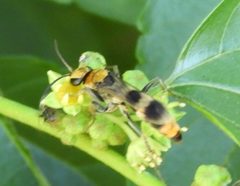
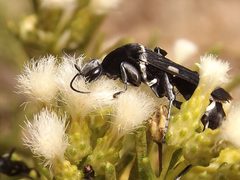
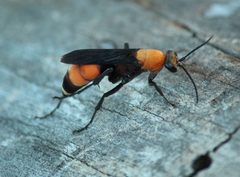
Aporini is a tribe of spider wasps within the Pompilidae, characterized by a widespread Holarctic and Neotropical distribution. Molecular phylogenetic studies indicate the tribe originated in the Nearctic region during the early Miocene approximately 22.6 million years ago. The group expanded its range through multiple independent events, including trans-Beringian movement to the Palearctic and over-water dispersals to the Caribbean and South America.
Pronunciation
How to pronounce Aporini: //ˌæpɔːˈraɪniː//
These audio files are automatically generated. While they are not always 100% accurate, they are a good starting point.
Images
Distribution
Nearctic and Palearctic regions (Holarctic), Neotropics including Mesoamerica and South America, and the Antilles. The tribe exhibits a widespread distribution achieved through multiple events rather than vicariance, including early Miocene expansion from the Nearctic across the Bering land bridge and later dispersals to South America via the Isthmus of Panama or across the Panama seaway.
More Details
Historical Biogeography
Phylogenetic analysis of four nuclear molecular markers (EF-1α F2 copy, long-wavelength rhodopsin, wingless, and 28S rRNA D2-D3 regions) supports a Nearctic origin for the tribe in the early Miocene. to the Palearctic occurred 15–18 million years ago across the Bering land bridge. Three independent dispersal events to South America from Mesoamerica took place after 18 million years ago. Three separate over-water dispersal events to the Antilles have been documented for two .
Research Methods
Biogeographic analyses employed statistical -vicariance analysis (S-DIVA), dispersal-extinction cladogenesis (DEC), and Bayesian binary Markov chain Monte Carlo (BBM) methods. A constrained DEC analysis allowing only dispersal to adjacent regions produced the highest likelihood and was mostly congruent with BBM results.