
Entypus unifasciatus
(Say, 1828)
spider wasp
Species Guides
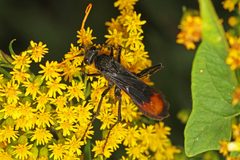
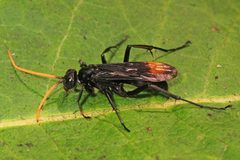
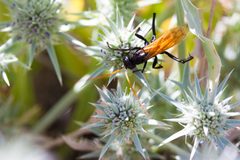
3Entypus unifasciatus is a spider wasp in the Pompilidae. Females hunt large spiders, paralyze them with venom, and provision underground burrows as food for their developing larvae. The species exhibits a broad transcontinental distribution across the Americas. display distinctive coloration with black bodies, bluish sheen, yellow , and variable orange-banded wings.
Pronunciation
How to pronounce Entypus unifasciatus: //ˈɛn.tɪ.pəs ˌjuː.nɪ.fæsˈsi.eɪ.təs//
These audio files are automatically generated. While they are not always 100% accurate, they are a good starting point.
Identification
Distinguished from other spider wasps by the combination of black body with bluish sheen, yellow , and the characteristic orange band near the wing apex. The wing band pattern is particularly diagnostic—ranging from extensive orange coloration to predominantly black wings with a single orange band. Within the Entypus, the specific wing pattern and coloration help separate it from . Similar Pompilidae may lack the yellow antennae or show different wing pigmentation patterns.
Images
Appearance
Medium to large spider wasp with predominantly black body exhibiting a bluish metallic sheen. yellow. Wings variable in coloration, ranging from mostly orange to mostly black with a distinct orange band near the apex (the 'unifasciatus' or 'one-banded' characteristic). Body robust with long legs typical of pompilid wasps.
Habitat
Open including grasslands, fields, and forest edges where large ground-dwelling spiders are abundant. Requires suitable soil substrates for burrow excavation. Often associated with areas supporting of large spider prey .
Distribution
Transcontinental North America from eastern regions westward, excluding the northwestern United States and Canada. Extends southward through Central America to South America. Absent from the Pacific Northwest and extreme northern Canada.
Seasonality
active during warm months; larvae overwinter as pupae and emerge as adults the following summer. Specific period varies by latitude and local climate conditions.
Diet
feed on nectar and other sources. Larvae are exclusively , feeding on living but paralyzed spiders provisioned by the female parent.
Host Associations
- Large spiders - preyParalyzed and cached in burrows as larval food source; specific spider not documented in sources
Life Cycle
Females excavate burrows in soil, hunt and paralyze large spiders, and transport them to the burrow. A single is laid on each spider. The larva hatches and feeds on the living but paralyzed spider, consuming it gradually. Upon completion of feeding, the larva spins a cocoon and pupates within the burrow. The pupal stage overwinters, with occurring the following summer. Unimodal pattern with one per year.
Behavior
Females exhibit solitary hunting , actively searching for large spiders. Upon encountering prey, the stings to induce paralysis, then transports the immobilized spider to a prepared burrow. The wasp has been observed to manipulate the spider into the burrow and oviposit before sealing the . Males are not involved in provisioning or nest construction.
Ecological Role
of large spiders; control agent for spider . As a , represents a terminal consumer in the for its larval stage. may contribute to pollination through nectar feeding.
Human Relevance
Generally not aggressive toward humans; stings primarily directed at spider prey. Ecological value as natural control of spider . Occasionally noticed by observers due to large size and conspicuous wing coloration. No significant economic impact documented.
Similar Taxa
- Other Pompilidae speciesSimilar body plan and spider-hunting ; distinguished by wing coloration pattern and yellow of E. unifasciatus
- Entypus fulvicornis with potentially overlapping distribution; differs in coloration and wing pattern
More Details
Subspecies
Four recognized: E. u. unifasciatus (Say, 1828), E. u. californicus (Townes, 1957), E. u. cressoni (Banks, 1929), and E. u. dumosus (Spinola, 1851). Geographic variation in wing coloration may correspond to subspecies boundaries.
Nesting biology
Unlike some spider wasps that use pre-existing cavities, E. unifasciatus females excavate their own burrows in soil. Each burrow typically contains one provisioned with a single large spider, though multiple cells per burrow have been reported in some .