
Dasymutilla magnifica
Mickel, 1928
Magnificent Velvet Ant
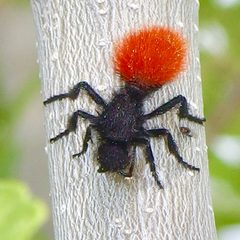
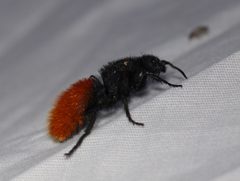
Dasymutilla magnifica, commonly called the magnificent velvet ant, is a wingless female in the Mutillidae found in arid regions of western North America. Like other velvet ants, females possess a potent sting used in defense and for subduing . The is notoriously difficult to distinguish from the sympatric Dasymutilla klugii based on external appearance alone. Males are winged and likely differ in coloration from females, though specific details for this species are not well documented.
Pronunciation
How to pronounce Dasymutilla magnifica: /ˌdæsɪˈmjuːtɪlə ˌmæɡˈnɪfɪkə/
These audio files are automatically generated. While they are not always 100% accurate, they are a good starting point.
Identification
Field identification is difficult due to close similarity in size and coloration to Dasymutilla klugii, which shares a partially overlapping range. No reliable external morphological characters for distinguishing these two in the field have been documented in available sources. Accurate identification may require examination of microscopic features or molecular analysis. Females are wingless; males possess wings.
Images
Habitat
Found in Mojave and Sonoran deserts, Arizona mountains, and the Great Basin region. Occurs in arid and semi-arid environments typical of velvet ant distribution in southwestern North America.
Distribution
Mojave Desert, Sonoran Desert, Arizona mountains, and Great Basin region of North America. Range overlaps partially with Dasymutilla klugii.
Human Relevance
Females can deliver a painful sting if handled; avoidance is recommended. The poses no significant agricultural or medical threat.
Similar Taxa
- Dasymutilla klugiiVery similar in size and coloration with partially overlapping geographic range, making field distinction unreliable
Sources and further reading
- BugGuide
- Wikipedia
- GBIF taxonomy match
- iNaturalist taxon
- NCBI Taxonomy
- Insect FAQs | Entomology Research Museum
- Bug Eric: Wasp Wednesday: Dasymutilla bioculata
- The gloriously dichromatic Dasymutilla gloriosa | Beetles In The Bush
- A sting to kill a cow? Red velvet ant, a.k.a. cow killer, Dasymutilla occidentalis — Bug of the Week
- Mutillidae | Beetles In The Bush
- Bees vs wasps: what's the difference? - Buglife Blog - Buglife