
Dasymutilla klugii
(Gray, 1832)
Klug's velvet ant
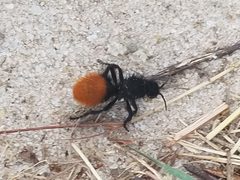
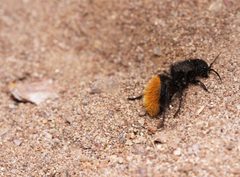
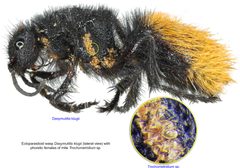
Dasymutilla klugii, commonly known as Klug's velvet ant, is a of in the Mutillidae. Despite the , it is not an but a solitary wasp. Females are wingless and possess a potent sting, while males are winged. The species is the most frequently encountered velvet ant in Texas and has been documented using -killer wasp nests (Sphecius grandis) as for its larvae. The specific epithet honors German entomologist Johann C. F. Klug.
Pronunciation
How to pronounce Dasymutilla klugii: //ˌdæzɪˈmjuːtɪlə ˈkluːdʒiaɪ//
These audio files are automatically generated. While they are not always 100% accurate, they are a good starting point.
Identification
As a member of the Dasymutilla, D. klugii can be distinguished from other velvet ant genera by features of the genus, though specific diagnostic traits for this are not detailed in available sources. The species is part of the Müllerian mimicry complex of North American velvet ants, which share aposematic coloration warning of their defensive sting.
Images
Habitat
Found in south-central North America; specific microhabitat preferences are not documented, but related in the are associated with open, sandy areas where nests occur.
Distribution
South-central North America, ranging from Utah to Puebla, Mexico. Most commonly encountered in Texas.
Host Associations
- Sphecius grandis - -killer nests are used to incubate young; larvae develop as of the 's .
Life Cycle
As with other Mutillidae, females are believed to deposit in nests. Larvae develop as ectoparasitoids, consuming the host larva or pupa. emerge from host nests. Specific developmental details for D. klugii are not documented.
Behavior
Females run rapidly across the ground while searching for nests, a typical of velvet ants. Both sexes have been observed producing audible squeaking sounds (stridulation) by rubbing abdominal segments together when disturbed.
Ecological Role
Acts as a of ground-nesting , potentially regulating of cicada-killer wasps and possibly other .
Human Relevance
Females can deliver a painful sting if handled; caution is advised. The is frequently encountered by observers in Texas, making it one of the more commonly observed velvet ants in its range.
Similar Taxa
- Dasymutilla occidentalisAnother large, brightly colored Dasymutilla with aposematic coloration; both are part of the same Müllerian mimicry complex and share the wingless female .
- Dasymutilla gloriosaSame with similar , though D. gloriosa females exhibit extreme sexual dichromatism with dense white setae resembling plant seeds.
More Details
Etymology
The specific epithet klugii honors Johann C. F. Klug, a German entomologist.
Sources and further reading
- BugGuide
- Wikipedia
- iNaturalist taxon
- NCBI Taxonomy
- Insect FAQs | Entomology Research Museum
- Bug Eric: Wasp Wednesday: Dasymutilla bioculata
- The gloriously dichromatic Dasymutilla gloriosa | Beetles In The Bush
- A sting to kill a cow? Red velvet ant, a.k.a. cow killer, Dasymutilla occidentalis — Bug of the Week
- Mutillidae | Beetles In The Bush
- Bees vs wasps: what's the difference? - Buglife Blog - Buglife