
Onycholyda
Takeuchi, 1938
Species Guides
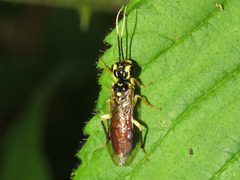
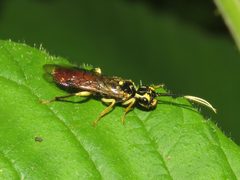
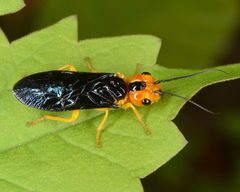
5Onycholyda is a of in the Pamphiliidae, established by Takeuchi in 1938. occur in Europe, North America, and China. Larvae feed on Rubus species (Rosaceae), with documented associations including Rubus inopertus and R. hirsutus. The genus includes at least six described species, with some larval stages and male specimens only recently described.
Pronunciation
How to pronounce Onycholyda: /ˌɒnɪˈkɒlɪdə/
These audio files are automatically generated. While they are not always 100% accurate, they are a good starting point.
Identification
can be distinguished from other Pamphiliidae by a combination of wing venation and antennal structure; larvae possess a distinct xanthogaster (yellow ) in at least one , aiding field identification. Molecular identification via COI barcode sequences has been validated for separating O. xanthogaster, O. fulvicornis, and O. tianmushana.
Images
Distribution
Europe; North America; China (Sichuan Province, Zhejiang Province including Mt. Tianmushan).
Diet
Larvae feed on Rubus (Rosaceae). Documented plants: Rubus inopertus for O. xanthogaster; Rubus hirsutus for O. fulvicornis.
Host Associations
- Rubus inopertus - larval Rosaceae; first record for O. xanthogaster
- Rubus hirsutus - larval Rosaceae; first record for O. fulvicornis
Life Cycle
Larval stage has been documented for O. xanthogaster and O. fulvicornis; male of O. tianmushana was described for the first time in 2017, suggesting incomplete life stage knowledge for some .
Ecological Role
Herbivore: larvae consume Rubus foliage, potentially influencing bramble in forest understories.
Similar Taxa
- Other Pamphiliidae generaShare general ; distinguished by antennal structure and wing venation patterns specific to Onycholyda
More Details
Taxonomic history
The was established by Takeuchi in 1938. Several have been described from East Asia by Shinohara (1999, 2006, 2016), with some species known only from female specimens until recent descriptions of associated males.
Molecular identification
COI mitochondrial barcodes have been successfully applied to identify larvae and match unassociated male specimens to described , particularly useful given the morphological similarity between species and incomplete life stage descriptions.