
Osmia taurus
Smith, 1873
Taurus Mason Bee
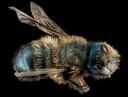
Osmia taurus is a native to eastern Asia that was accidentally introduced to North America, first recorded in Maryland and West Virginia in 2002. The has undergone rapid expansion across the eastern United States, with established populations now confirmed in Canada (Ontario and Quebec). Its spread has been linked to commercial shipments of the intentionally introduced Osmia cornifrons, with which it is frequently confused. Population growth of O. taurus in the Mid-Atlantic region reached 800% over 15 years, coinciding with documented declines of 76–91% in six native mason bee species.

Pronunciation
How to pronounce Osmia taurus: /ˈɔs.mi.ə ˈtaʊ.rʊs/
These audio files are automatically generated. While they are not always 100% accurate, they are a good starting point.
Identification
Morphologically similar to Osmia cornifrons, with which it is frequently confused; males of both possess horn-like projections on the . Accurate identification requires examination of male genitalia or (BIN BOLD:AAI2020). Females are more difficult to distinguish and may require dissection or genetic analysis. Both species are readily distinguished from the bright red European species Osmia cornuta.
Images
Habitat
Urban areas, private residential yards, and seminatural public parks with meadow and woodland vegetation. Nests in pre-existing cavities including hollow plant stems, holes in wood left by other insects, and artificial trap nests ( hotels). Readily colonizes human-modified environments.
Distribution
Native to eastern Asia (Japan and broader region). Introduced to North America: first detected in Maryland and West Virginia in 2002, now established from Florida to New Hampshire in the eastern United States. Established in Canada with confirmed in Toronto, Ontario (2017–2020 sampling) and records from southern Ontario and Montreal, Quebec.
Seasonality
Spring-active; emerges to coincide with flowering of spring-blooming trees and shrubs. activity period overlaps with that of native Osmia lignaria.
Diet
pollen collector; has been observed visiting eastern redbud (Cercis canadensis) and spring-flowering fruit trees and shrubs. Specific pollen range remains incompletely documented.
Life Cycle
; spends much of in temperature-dependent within cocoon. Gregarious; constructs in linear series toward apex of cavity, partitioned by mud walls. Brood cells can be harvested and moved; can increase 3–5× annually under optimal conditions.
Behavior
Exhibits prolonged post-copulatory phase lasting approximately 58 minutes (mean 3,501.8 ± 1,606.7 seconds) following brief copulation (17.5 ± 4.4 seconds). Females are monandrous: receptivity declines rapidly with age, with over 60% of newly emerged virgin females mating but no mating observed in 2–3-day-old virgins. Females lose receptivity permanently after single mating and do not regain it after 7–9 days. Rapid decline in female attractiveness after mating suggests changes in pheromonal communication.
Ecological Role
of spring-flowering plants. Documented competitor with native mason bees for nesting cavities; rapid growth associated with concordant declines in native Osmia . Potential of including chalkbrood fungus (Ascosphaera) to native bees; fungal pathogens more abundant in areas where non-native Osmia species occur. Possible role in facilitating spread of plants through pollination, though this requires further research.
Human Relevance
Accidentally introduced through commercial trade, mixed with shipments of Osmia cornifrons cocoons. Poses economic concern for native conservation and commercial mason bee industry; some U.S. states restrict non-native bee imports due to risks. science monitoring recommended for detection and tracking.
Similar Taxa
- Osmia cornifronsMorphologically similar with overlapping size range and male facial horns; historically confused in field observations and commercial shipments. Distinguished by male genitalia and distinct barcode (BIN BOLD:AAI2020 for O. taurus vs. separate BIN for O. cornifrons).
- Osmia lignariaNative North American with similar , nesting , and pollen use; O. taurus has displaced O. lignaria in some areas through competition for nesting resources.
- Osmia cornutaEuropean recently established in western North America; both are non-native Osmia species with potential for range expansion through commercial shipments, but O. cornuta is bright red and readily distinguished by color.
Sources and further reading
- BugGuide
- GBIF taxonomy match
- iNaturalist taxon
- NCBI Taxonomy
- Catalogue of Life
- Is This Non-Native Mason Bee an Invasive Species?
- European Mason Bee Lands in North America's Pacific Northwest, Likely to Spread
- Establishment of the non-native horned-face bee Osmia cornifrons and the taurus mason bee Osmia taurus (Hymenoptera: Megachilidae) in Canada
- Osmia taurus (Hymenoptera: Megachilidae): A Non-native Bee Species With Invasiveness Potential in North America
- Mating behavior and female receptivity in a Japanese mason bee Osmia taurus ( Hymenoptera: Megachilidae )