
Megachile xylocopoides
Smith, 1853
Carpenter-mimic Leafcutter Bee
Megachile xylocopoides is a solitary leafcutter bee native to the eastern United States, named in 1853 by Smith for its superficial resemblance to carpenter bees in the Xylocopa. Like other members of the genus Megachile, females cut circular pieces from leaves to construct chambers within pre-existing cavities. The is part of the diverse native fauna of North America and contributes to pollination of wild plants and crops in its range.
Pronunciation
How to pronounce Megachile xylocopoides: /ˌmɛɡəˈkaɪli ˌzaɪləˈkoʊpɔɪdiz/
These audio files are automatically generated. While they are not always 100% accurate, they are a good starting point.
Identification
Distinguished from true carpenter bees (Xylocopa) by its smaller size and different abdominal structure; Megachile xylocopoides lacks the shiny, hairless typical of many Xylocopa . The species carries pollen on the underside of the abdomen (a megachilid trait) rather than in corbiculae on the hind legs. Specific distinguishing features from other Megachile species in the eastern United States are not documented in available sources.
Images
Appearance
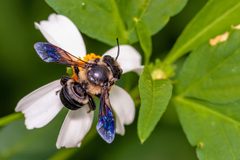
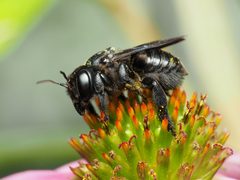
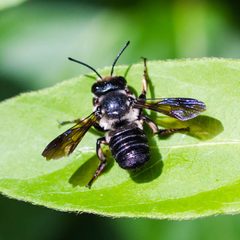
Medium-sized with a robust, somewhat flattened body form that superficially resembles carpenter bees (Xylocopa). Females carry pollen on the surface of the (scopa) rather than on the hind legs. Coloration and specific markings are not well-documented in available sources.
Habitat
Found in diverse environments across its eastern US range, including urban and suburban gardens, parks, and natural areas with suitable nesting substrates and floral resources. Like other cavity-nesting bees, it requires pre-existing holes in wood or other materials for nest construction.
Distribution
Eastern United States, ranging from eastern Texas northward to southeast Pennsylvania.
Diet
feed on nectar from flowers; larvae are provisioned with pollen and nectar collected by females. Specific floral associations are not documented in available sources.
Life Cycle
Solitary with females constructing individual nests in pre-existing cavities. Nests are lined with circular leaf pieces cut by the female to form , each provisioned with pollen and nectar and containing a single . Developmental timing and number of per year are not documented in available sources.
Behavior
Females cut neat circular pieces from leaves to construct chambers within cavities. The is solitary, with no cooperative nesting or social structure. Males do not participate in nest construction or provisioning.
Ecological Role
of wild plants and potentially crops within its range. As a cavity-nesting , it utilizes pre-existing holes rather than excavating its own, making it dependent on dead wood, hollow stems, or other substrates with suitable cavities.
Human Relevance
Contributes to pollination in gardens and agricultural settings; may be supported by providing hotels or nesting blocks with appropriately sized holes. The leaf-cutting can cause minor aesthetic damage to ornamental plants, though this is generally insignificant.
Similar Taxa
- Xylocopa (carpenter bees)Megachile xylocopoides was named for its superficial similarity to carpenter bees, but differs in size, nesting (using pre-existing cavities vs. excavating wood), and pollen-carrying structure (abdominal scopa vs. leg corbiculae).
- Other Megachile speciesMany eastern US Megachile share the leaf-cutting and general body form; specific diagnostic features distinguishing M. xylocopoides from are not documented in available sources.
More Details
Taxonomic Etymology
The specific epithet xylocopoides derives from Greek xylokopos (wood-cutter) and the suffix -oides (resembling), referring to the ' resemblance to carpenter bees in the Xylocopa.
Sources and further reading
- BugGuide
- Wikipedia
- GBIF taxonomy match
- iNaturalist taxon
- Catalogue of Life
- Looking for Cheap Urban Real Estate | Bug Squad
- In Search of the World's Biggest Bee: How It Came to 'Bee' | Bug Squad
- Photographer Allan Jones Exudes Patience, Skill and Talent | Bug Squad
- The Most Incredible Image of a Leafcutter Bee | Bug Squad
- The Native Bees in the UC Davis Bee Haven | Bug Squad
- UC Davis: All A'Buzz With Bee Nests and Art | Bug Squad