
Megachile umbripennis
Smith, 1853
Shadow-winged Resin Bee
Megachile umbripennis, commonly known as the Shadow-winged Resin , is a solitary bee in the Megachilidae. It was first described by Frederick Smith in 1853. The species is notable for its characteristically dark, shadow-colored wings, from which its derives. It has been recorded across a broad geographic range spanning southern Asia, various Pacific islands, Australia, and the eastern coast of the United States.
Pronunciation
How to pronounce Megachile umbripennis: /ˌmɛɡəˈkaɪli ˌʌmbriˈpɛnɪs/
These audio files are automatically generated. While they are not always 100% accurate, they are a good starting point.
Identification
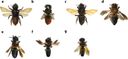
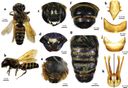
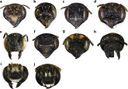
The dark, shadow-colored wings (reflected in both the epithet 'umbripennis' and 'Shadow-winged Resin ') provide the primary diagnostic character separating this species from similar Megachile. Within its range, it may be confused with other resin-collecting megachilids, though the wing coloration appears distinctive. Detailed morphological characters for definitive identification require examination of specimens.
Images
Appearance
Medium-sized solitary with notably dark, shadow-colored wings that distinguish it from . As a member of Megachilidae, it carries pollen on scopal hairs located on the underside of the rather than on the hind legs. The exhibits the general Megachile body plan with a robust, somewhat cylindrical form and strong adapted for manipulating resin and other nest materials.
Habitat
Specific requirements are not well documented. Based on its distribution across tropical and subtropical regions of southern Asia, Pacific islands, and subtropical eastern North America, the likely occupies warm, relatively humid environments. As a resin , it presumably requires access to plant sources of resin for nest construction.
Distribution
Broadly distributed across southern Asia, various Pacific islands, Australia, and the eastern coast of the United States. GBIF records confirm presence in Australia. The disjunct distribution pattern suggests either natural range expansion or human-mediated introduction to some areas, though this has not been formally assessed.
Diet
As with other Megachile , are nectar feeders and larvae are provisioned with pollen. Specific plant associations have not been documented.
Life Cycle
As a solitary in Megachilidae, females nest independently and provision with pollen. The is known to collect resin for nest construction (hence 'resin bee' ), though specific nesting substrates and cell construction details are not documented. Developmental timing and number of per year are unknown.
Behavior
Solitary nesting with resin collection for nest construction. No specific behavioral observations beyond general -level traits have been published.
Ecological Role
Likely functions as a within its range. As a resin , it may compete for nesting sites with other cavity-nesting insects, though this has not been studied. Its ecological impacts in North America, where it appears to be non-native, remain unassessed.
Human Relevance
No documented economic importance or direct interactions with humans. The has been observed in urban and suburban environments on the eastern coast of the United States, suggesting some capacity to utilize human-modified landscapes.
Similar Taxa
- Megachile sculpturalis (Giant Resin Bee)Also a resin-collecting Megachile with dark coloration, but substantially larger and native to Asia with established introduced in eastern North America. M. umbripennis differs in its wing coloration being the namesake feature rather than overall body size.
- Other Megachile speciesMany share general body form and pollen-carrying . M. umbripennis is distinguished by its characteristic dark wings, though confirmation may require expert identification.
More Details
Taxonomic History
Described by Frederick Smith in 1853, with the specific epithet 'umbripennis' (shadow-winged) directly referencing the dark wing coloration that remains its most notable feature.
Distribution Anomalies
The ' occurrence on the eastern coast of the United States alongside its native Asian and Pacific range raises questions about introduction history that have not been formally investigated.
Sources and further reading
- BugGuide
- Wikipedia
- GBIF taxonomy match
- iNaturalist taxon
- NCBI Taxonomy
- Catalogue of Life
- Looking for Cheap Urban Real Estate | Bug Squad
- In Search of the World's Biggest Bee: How It Came to 'Bee' | Bug Squad
- Photographer Allan Jones Exudes Patience, Skill and Talent | Bug Squad
- The Most Incredible Image of a Leafcutter Bee | Bug Squad
- The Native Bees in the UC Davis Bee Haven | Bug Squad
- Mailbox posts are fine homes for giant resin bees, Megachile sculpturalis — Bug of the Week