
Coelioxys sayi
Robertson, 1897
Say's Cuckoo Leafcutter Bee
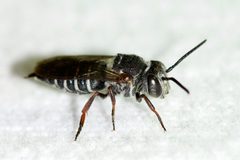
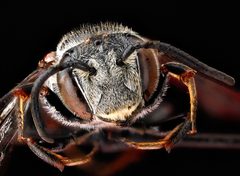
Coelioxys sayi is a of kleptoparasitic in the Megachilidae, commonly known as Say's Cuckoo Leafcutter Bee. As a member of the sharp-tailed bee Coelioxys, this species does not construct its own nests but instead parasitizes the nests of other solitary bees, particularly leafcutter bees (Megachile spp.). Females possess a pointed adapted for inserting into nest . The species occurs in North America and is active during the summer months when host species are nesting.
Pronunciation
How to pronounce Coelioxys sayi: /sɛɪliˈaɪəksɪs ˈseɪi/
These audio files are automatically generated. While they are not always 100% accurate, they are a good starting point.
Identification
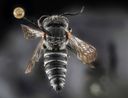
Distinguished from other Coelioxys by combination of size, facial markings, and abdominal patterning; precise identification often requires examination of genitalia in males and abdominal tip structure in females. Separated from leafcutter bees (Megachile) by the pointed female , lack of scopal hairs for pollen transport, and more slender, -like build. Distinguished from other cleptoparasitic such as Nomada by the pointed rather than rounded abdominal apex and different thoracic proportions. Distinguished from Sphecodes (blood bees) by coloration—Coelioxys lacks the bright red or orange typical of many Sphecodes species.
Images
Habitat
Open including meadows, grasslands, gardens, and woodland edges where leafcutter bees nest. Nesting of host bees are the critical habitat feature. Often found in areas with exposed soil banks, hollow stems, or pre-existing cavities used by Megachile .
Distribution
North America. Documented from the United States including Vermont and other eastern states. GBIF records indicate presence across North America with specific observations from Vermont, US.
Seasonality
active primarily in summer months (June–August), coinciding with the nesting period of Megachile . tracks host availability; timed to access active host nests.
Host Associations
- Megachile - kleptoparasiteParasitizes nests of leafcutter bees. Female enters nest and inserts through partition; larva consumes host egg/larva and stored provisions.
Life Cycle
Holometabolous with complete . Female locates active nest, waits for host female to depart, then enters and pierces partition with pointed to deposit . Coelioxys larva hatches first, kills host egg or young larva, and consumes pollen-nectar provision. Develops through larval instars, pupates within host cell, and emerges as the following season or later in same season depending on host .
Behavior
Kleptoparasitic: does not construct nests or collect pollen or nectar. Females spend considerable time observing potential nests, sometimes hovering near nest entrances. Host detection likely involves chemical cues. Males patrol areas with host seeking females. Limited defensive due to lack of nest or food stores to protect.
Ecological Role
Acts as a regulator of leafcutter bee populations. As a kleptoparasite, contributes to dynamics and may influence nesting success and distribution. Participates in pollination only incidentally through contact with flowers during nectar feeding.
Human Relevance
Generally not of direct economic importance. Occasionally observed in gardens and urban green spaces where leafcutter bees nest. Not aggressive; lacks stinging defense of social bees. Presence indicates healthy of host bees and suitable nesting .
Similar Taxa
- Coelioxys sodalisSimilar size and coloration; distinguished by subtle differences in abdominal punctation and male genitalia structure. Often sympatric and shares .
- Coelioxys octodentataOverlapping range; distinguished by more extensive pale markings and different abdominal tip in females.
- NomadaSimilar kleptoparasitic lifestyle and -like appearance; distinguished by rounded abdominal apex, different wing venation, and often more vivid yellow-red-black patterning.
- SphecodesSimilar slender parasitic form; distinguished by frequently red or orange abdominal coloration and different proportions.
More Details
Etymology
Specific epithet 'sayi' honors Thomas Say (1787–1834), pioneering American entomologist often called the father of American entomology.
Sources and further reading
- BugGuide
- GBIF taxonomy match
- iNaturalist taxon
- NCBI Taxonomy
- Catalogue of Life
- From Caterpillars to Butterflies to Chronic Pain Research | Bug Squad
- Bruce Hammock: From ResearchIng Insect Science to Researching Autism and Schizophrenia | Bug Squad
- Bug Eric: Stop Saying the Monarch is a "Gateway Species" for an Appreciation of Other Insects
- Not-so Solitary Bees - Buglife Blog - Buglife
- Bug Eric: Spider Sunday: Funnel-web Wolf Spiders
- Termite Experts Attempt to Solve Taxonomic Cold Cases