
Coelioxys octodentatus
Say, 1824
Eight-toothed Cuckoo Leaf-cutter Bee
Coelioxys octodentatus is a kleptoparasitic in the Megachilidae, commonly known as the Eight-toothed Cuckoo Leaf-cutter Bee. As a member of the Coelioxys, it parasitizes nests of leaf-cutter bees (Megachile spp.) rather than constructing its own. Females deposit into nest , and their larvae eliminate the host egg or larva before consuming the pollen provisions. The occurs in North America, with records from the United States and Middle America.
Pronunciation
How to pronounce Coelioxys octodentatus: //ˌsiːliˈɒksɪs ˌɒktoʊdɛnˈteɪtəs//
These audio files are automatically generated. While they are not always 100% accurate, they are a good starting point.
Identification
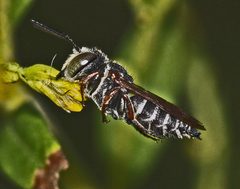
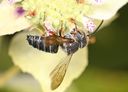
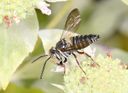
Coelioxys octodentatus can be distinguished from other Coelioxys by the eight teeth on the margin of the female's metasoma (), which give the species its . Males have a more slender, pointed abdomen without such teeth. Members of this are generally -like in appearance with reduced body hair compared to their Megachile . The pointed or sharp-tailed abdomen is characteristic of the genus and aids in insertion into host nest .
Images
Distribution
North America including the United States (with confirmed records from Vermont) and Middle America.
Host Associations
- Megachile - KleptoparasiteFemales deposit into nest ; larvae kill host egg or larva and develop on host-provided pollen provisions.
Behavior
Females are known to hover near active Megachile nesting sites and enter unguarded nest holes to deposit . The exhibits kleptoparasitic where females do not construct nests or collect pollen, instead relying entirely on provisioning. Males have been observed visiting flowers, including artichoke blossoms.
Ecological Role
As a kleptoparasite, Coelioxys octodentatus functions as a regulator of leaf-cutter . This parasitic relationship is a natural component of native bee dynamics.
Similar Taxa
- NomadaBoth are kleptoparasitic bees, but Nomada parasitize Andrenidae (mining bees) rather than Megachilidae, and typically exhibit yellow, red, and black coloration patterns unlike the more uniformly dark Coelioxys.
- SphecodesBlood bees are also kleptoparasitic, but target Halictidae (furrow bees) and have distinctive red coloration not seen in Coelioxys.
- Megachile are frequently confused with Coelioxys due to shared (Megachilidae), but Megachile have hairy bodies for pollen transport and lack the pointed, toothed of female Coelioxys.