
Paranthidium
Cockerell & Cockerell, 1901
Species Guides
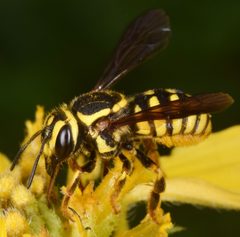
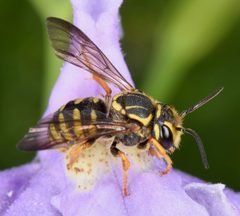
1- Paranthidium jugatorium(Sunflower Burrowing-Resin bee)
Paranthidium is a of bees in the Megachilidae, tribe Anthidiini, established by Cockerell & Cockerell in 1901. The genus contains seven described distributed in North and Central America. Members are solitary bees that construct nests using collected materials. Little is known about the of most species, with P. jugatorium being the most frequently observed and studied.
Pronunciation
How to pronounce Paranthidium: /ˌpærænˈθɪdiəm/
These audio files are automatically generated. While they are not always 100% accurate, they are a good starting point.
Identification
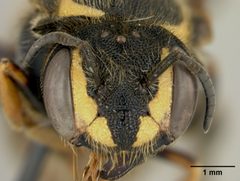
Paranthidium can be distinguished from related anthidiine by their compact body form and specific wing venation patterns. The genus is characterized by a combination of features including the shape of the scutellum and the structure of the male genitalia. Species-level identification requires examination of subtle morphological differences in coloration patterns and body proportions.
Images
Distribution
ranges from the United States (including Vermont) through Mexico to Central America. Records indicate presence in temperate and subtropical regions of North America.
Ecological Role
As members of Megachilidae, Paranthidium function as . They carry pollen on the underside of the (scopa) rather than on the hind legs. Their specific plant associations and pollination services remain poorly documented.
Similar Taxa
- AnthidiumBoth are in tribe Anthidiini and share general body plan; Paranthidium is distinguished by more compact form and different scutellum shape
- DianthidiumAnother anthidiine with overlapping distribution; differs in nest construction materials and male genitalia structure
More Details
Taxonomic history
The was established by Theodore Dru Alison Cockerell and his wife in 1901, with P. jugatorium as the type . The genus has remained relatively stable taxonomically, though species-level revisions are needed.
iNaturalist observations
The has accumulated 939 observations on iNaturalist, suggesting moderate detectability but limited specialized study.