
Dianthidium floridiense
H.F. Schwarz, 1926
Florida Pebble Bee
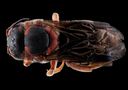
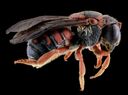
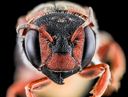
Dianthidium floridiense is a of resin in the Megachilidae, commonly known as the Florida Pebble Bee. It is native to North America and belongs to a of solitary bees that construct nests using plant resins. Like other Dianthidium species, females likely nest in pre-existing cavities such as hollow twigs or borings in dead wood, partitioning with resin walls and sealing the entrance with a resin plug. The species is part of a group known as "pebble bees" or "resin bees" due to their distinctive nest construction .
Pronunciation
How to pronounce Dianthidium floridiense: //daɪænˈθɪdiəm flɒrɪˈdiɛns//
These audio files are automatically generated. While they are not always 100% accurate, they are a good starting point.
Identification
Dianthidium floridiense can be distinguished from other Dianthidium by subtle morphological characters including body size, coloration patterns, and specific features of the abdominal scopa and mandibular structure. The Dianthidium is characterized by females that carry pollen on the underside of the ( scopa) rather than on the hind legs, and by their use of resin in nest construction. Species-level identification typically requires examination of microscopic features such as the form of the margin of the sixth in females and genitalia in males.
Images
Habitat
Specific details for D. floridiense are not well documented in available sources. Members of the Dianthidium generally inhabit areas with suitable nesting substrates (dead wood with borings or hollow twigs) and access to floral resources for pollen and nectar collection, as well as sources of plant resin for nest construction.
Distribution
North America. The specific epithet "floridiense" suggests a primary association with Florida, though the exact range boundaries within North America are not precisely documented in available sources.
Behavior
As a member of the Dianthidium, females likely exhibit solitary nesting , utilizing pre-existing cavities in dead wood or hollow plant stems. Females construct nest partitioned by walls of plant resin, provision each cell with a pollen-nectar mixture (""), lay an , and seal completed nests with a resin plug. The is known to be parasitized by sapygid ( Sapygidae), which lay eggs in active nests, and by leucospid wasps (family Leucospidae), whose larvae attach to and consume the larvae.
Ecological Role
As a solitary , D. floridiense likely serves as a of native flowering plants within its range. The also functions as a for parasitic in Sapygidae and Leucospidae, contributing to local dynamics. Its resin-gathering may influence plant resin availability and distribution in its .
Human Relevance
Dianthidium floridiense has been documented using artificial blocks or "bee condos" installed for native bee conservation, indicating potential value for enhancement efforts. The is of interest to apiologists and native bee enthusiasts monitoring artificial nesting structures.
Similar Taxa
- Other Dianthidium speciesShare the same -level characteristics including resin-based nest construction, scopa for pollen transport, and similar overall body plan. Distinguishing requires detailed morphological examination.
- Heriades speciesAlso mason bees in Megachilidae that use resin for nest construction and have similar nesting . Heriades are generally smaller and have different mandibular and scopal structures.
- Osmia speciesOther megachilid mason bees that nest in pre-existing cavities, though Osmia typically use mud or chewed leaf material rather than resin for partitions, and often have metallic coloration not typical of Dianthidium.
More Details
Parasite associations
Dianthidium floridiense has been specifically mentioned in observations of artificial blocks where it was noted as a for parasitic . The comment 'In another location, at the nature park where we volunteer we've had Dianthidium nesting in the bee box there' from a Texas observer indicates the utilizes artificial nesting structures. Additionally, leucospid wasps ( Leucospidae) are documented of Dianthidium species generally, with Leucospis affinis specifically noted as parasitizing resin bees including Dianthidium.
Taxonomic history
The was described by H.F. Schwarz in 1926. The Dianthidium belongs to the tribe Anthidiini within the Megachilinae, a group characterized by the use of foreign materials (resins, plant fibers, mud) in nest construction.