
Anthidium maculifrons
Smith, 1854
Spot-fronted Wool-carder Bee
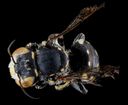
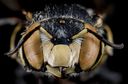
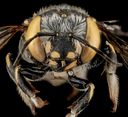
Anthidium maculifrons is a of wool- in the Megachilidae, native to North and Middle America. Like other members of its , females collect plant fibers from hairy leaves to construct their nests, a that gives the group its . Males are known to be territorial and defend floral resources. The species is distinguished from by specific markings on the .
Pronunciation
How to pronounce Anthidium maculifrons: /ænˈθɪdiəm mæˌkjuːlɪˈfrɒnz/
These audio files are automatically generated. While they are not always 100% accurate, they are a good starting point.
Identification
Distinguished from other Anthidium by maculations (spots or markings) on the ; specific pattern of pale markings on the distinguishes it from the widespread European wool carder bee (Anthidium manicatum), which has been introduced to North America. Females possess the characteristic dense scopal hairs on the underside of the for carrying pollen, typical of Megachilidae.
Images
Distribution
Recorded from the United States and Mexico; distribution spans Middle America and North America.
Ecological Role
As a member of Megachilidae, serves as a ; females are solitary nesters that provision with pollen and nectar.
Similar Taxa
- Anthidium manicatumEuropean wool carder bee introduced to North America; males similarly territorial but differs in facial markings and overall distribution
Sources and further reading
- BugGuide
- Wikipedia
- GBIF taxonomy match
- iNaturalist taxon
- Catalogue of Life
- Not a Terrorist | Bug Squad
- The Wonderful World of Insects | Bug Squad
- Primary Type List | Entomology Research Museum
- Summer stingers – Eastern yellowjackets, Vespula maculifrons — Bug of the Week
- Feeling yellow - Yellow Jackets, Vespula maculifrons — Bug of the Week
- Be careful around yellowjackets: Eastern yellowjackets, Vespula maculifrons — Bug of the Week