
Phygadeuontini
Tribe Guides
9Phygadeuontini is the sole tribe in the Phygadeuontinae, a diverse group of ichneumon wasps. The tribe comprises approximately 123 organized into 12 subtribes with worldwide distribution. Members are koinobiont endoparasitoids, primarily attacking concealed such as pupae and larvae of other insects. The subtribes are distinguished by morphological and biogeographic patterns, with some subtribes showing restricted distributions while others are .
Pronunciation
How to pronounce Phygadeuontini: //faɪɡəˈduːˌɒntɪnaɪ//
These audio files are automatically generated. While they are not always 100% accurate, they are a good starting point.
Identification
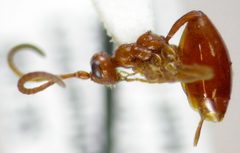
Phygadeuontini is distinguished from other ichneumonid tribes by the combination of a complete, non-abbreviated areolet in the forewing, a closed first discoidal , and the absence of a glymma on the first tergite. The tribe exhibits considerable morphological diversity across its 12 subtribes, with body sizes ranging from small to minute. Subtribe-level identification requires examination of clypeal structure, ovipositor length relative to body, and details of the propodeal . The Gelis (subtribe Gelina) is particularly notable for its highly reduced wing venation and -like appearance in some .
Images
Habitat
span virtually all terrestrial where insects occur, from tropical rainforests to tundra. Members are found in forest , understory vegetation, soil litter, and environments. Many are associated with decaying wood, leaf litter, and other substrates where concealed hosts are abundant. The tribe's ecological breadth reflects its host-tracking strategy rather than specific habitat requirements.
Distribution
Worldwide distribution with all major biogeographic regions represented. Subtribes show varying patterns: Chiroticina and Rothneyiina are predominantly Oriental and Ethiopian; Cremnodina and Phygadeuontina are primarily Holarctic; Gelina is . Some such as Isdromas and Dichrogaster achieve nearly global distribution. The Hawaiian Islands support representatives (e.g., Agasthenes).
Seasonality
Activity patterns vary by latitude and . Temperate are primarily active from spring through autumn, with peak abundance coinciding with host larval and pupal stages. Tropical species show less pronounced seasonality, with year-round activity in suitable . Many species exhibit extended longevity, potentially spanning multiple host .
Diet
All members are . include pupae and larvae of Lepidoptera, Coleoptera, Diptera, Hymenoptera, and occasionally other orders. Many are hyperparasitoids, attacking primary parasitoids within their hosts. The Gelis is known to attack spider sacs in addition to insect hosts. Host relationships are generally poorly documented at species level.
Life Cycle
Koinobiont endoparasitoid development: females oviposit into or near concealed ; larvae develop within the living host, emerging to pupate externally or within the host remains. Developmental timing is synchronized with host physiology. Many produce multiple per year where climate permits. in the pupal stage is common in temperate species.
Behavior
are often cryptic and difficult to observe, with many rarely encountered despite apparent abundance. Females locate concealed using vibrational and chemical cues, with some species demonstrating remarkable host-finding ability in complex substrates. Males frequently establish territories near sites or host . -like locomotion and in Gelis species may represent mimicry facilitating host access.
Ecological Role
Significant regulators of concealed herbivore , particularly in forest and soil . Hyperparasitoid members contribute to trophic complexity in . The tribe's association with woody substrates and leaf litter makes them important components of decomposition . Some may serve as indicators of continuity due to specific requirements.
Human Relevance
Limited direct economic importance. Some have been investigated for of concealed pests such as wood-boring beetles and stored product insects. The tribe's cryptic and taxonomic complexity have made it a focus of systematic research rather than applied entomology. No species are known to pose direct risks to human health or agriculture.
Similar Taxa
- Other Ichneumonidae tribesPhygadeuontini is distinguished from most other ichneumonid tribes by the complete areolet and absence of glymma; the Phygadeuontinae was historically confused with Cryptinae and other groups, but molecular and morphological data support its distinctiveness as the sole tribe in its subfamily.
More Details
Classification history
The tribal and subtribal classification of Phygadeuontini has undergone substantial revision, with Wahl (2014) providing the current framework of 12 subtribes. Many were historically placed in Cryptinae or treated as incertae sedis within Ichneumonidae.
Research challenges
The tribe remains poorly known biologically, with records available for only a small fraction of . The minute size of many members, particularly in subtribe Gelina, contributes to undercollection and limited ecological study.