
Asobara
Förster, 1862
Asobara is a of in the Braconidae containing approximately forty . The genus is best known as parasitoids of Drosophila larvae, with Asobara tabida serving as a major model organism for studying parasitoid- interactions and the hologenome concept. Members of this genus lack , instead employing venom-based strategies to suppress host immune defenses. Several species, including A. tabida and A. japonica, exhibit obligate or facultative associations with endosymbionts that influence and host-finding .
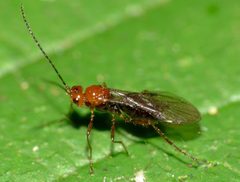
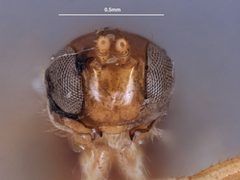
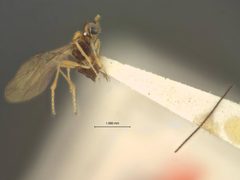
Pronunciation
How to pronounce Asobara: /ˌæs.oʊˈbɛr.ə/
These audio files are automatically generated. While they are not always 100% accurate, they are a good starting point.
Identification
Asobara are small braconid wasps that can be distinguished from other Drosophila by their lack of and their reliance on venom components for immune suppression. Species-level identification requires examination of morphological features such as wing venation, structure, and body proportions. A. tabida and A. japonica are among the most studied species, with A. japonica notably possessing virus-like particles in its venom that require neutralization by lateral components for successful .
Images
Distribution
within the have been documented from Japan (including Tokyo and Iriomote-jima island), with distribution records also from Denmark and Sweden based on GBIF data. Specific preferences in natural settings are not well documented.
Host Associations
- Drosophila melanogaster - primary habitual for A. tabida and A. japonica; supports complete development
- Drosophila simulans - rearing for A. japonica; A. tabida shows virtually zero survival probability but will oviposit, especially when larvae are already parasitized by Leptopilina boulardi
- Drosophila ficusphila - non-habitual for A. japonica; possesses intrinsic active venom neutralizers in
- Drosophila bipectinata - non-habitual for A. japonica; possesses intrinsic active venom neutralizers in
Life Cycle
develop internally within larvae. Females oviposit into Drosophila larvae, with and larval stages developing inside the host. Pupariation occurs within the host, and wasps emerge from host pupae. The is tightly coupled to host larval development.
Behavior
Asobara tabida exhibits kleptoparasitic , ovipositing into D. simulans larvae that have already been parasitized by the Leptopilina boulardi, thereby gaining access to a that would otherwise be unsuitable. -infected strains of A. japonica show enhanced host-searching ability and increased oviposition frequency during the first two days after , attributed to improved olfactory response to host odors. Females inject venom followed by lateral components to neutralize venom and enable progeny survival.
Ecological Role
Endoparasitoids of Drosophila that exert selection pressure on and drive evolution of host resistance mechanisms. The represents a model system for studying host- , with documented rapid evolution of host resistance and associated trade-offs in host competitive ability.
Human Relevance
Asobara tabida is a significant model organism for research in , - , and the hologenome theory of evolution. The obligate dependence of A. tabida has made it a key study system for understanding evolutionary transitions in host- relationships. Research on Asobara venom components has contributed to understanding of immune suppression mechanisms in parasitoid-host interactions.
Similar Taxa
- LeptopilinaBoth are of Drosophila larvae, but Leptopilina are in the Fainacidae (formerly Eucoilidae) and possess virus-like particles in their venom, whereas Asobara species lack and use distinct venom strategies involving virus-like particles only in some species like A. japonica.
More Details
Wolbachia Symbiosis
Asobara tabida is commensally infected with and cannot reproduce in the absence of Wolbachia , representing a case of obligate mutualism. Asobara japonica shows strain variation: the Tokyo (TK) strain is Wolbachia-infected and capable of parthenogenetic producing only female offspring, while the Iriomote (IR) strain is uninfected and reproduces sexually.
Venom and Immune Evasion
Unlike many braconid , Asobara lack . A. japonica venom contains virus-like particles (20-40 nm diameter) that are essential for preventing cellular immune defenses. The venom is neutralized not directly by lateral components, but through activation of a neutralizer precursor present in host . This mechanism allows successful of multiple Drosophila species.
Sources and further reading
- BugGuide
- Wikipedia
- GBIF taxonomy match
- iNaturalist taxon
- NCBI Taxonomy
- Catalogue of Life
- Evolutionary interactions between Drosophila melanogaster and its parasitoid Asobara tabida
- Characterization of Venom and Oviduct Components of Parasitoid Wasp Asobara japonica
- Bacteria Endosymbiont, Wolbachia, Promotes Parasitism of Parasitoid Wasp Asobara japonica
- Chapter 8 Components of Asobara Venoms and their Effects on Hosts
- Chapter 9 Strategies of Avoidance of Host Immune Defenses in Asobara Species
- Absence of Complementary Sex Determination in the Parasitoid Wasp Genus Asobara (Hymenoptera: Braconidae)
- Chapter 7 Immune Resistance of Drosophila Hosts Against Asobara Parasitoids
- Asobara, braconid parasitoids of Drosophila larvae: unusual strategies to avoid encapsulation without VLPs
- Deadly venom of Asobara japonica parasitoid needs ovarian antidote to regulate host physiology
- Évolution de la dépendance dans les symbioses à Wolbachia : étude du genre Asobara (Hymenoptera : braconidae)
- Cellular immune response of Drosophila melanogaster against Asobara tabida
- When Parasitoids Lack Polydnaviruses, Can Venoms Subdue the Hosts? The Case Study of Asobara Species
- Kleptoparasitism as an explanation for paradoxical oviposition decisions of the parasitoid Asobara tabida
- Sex ratio adjustment in Asobara persimilis (Hymenoptera: braconidae), a parasitoid of Drosophila
- Adaptive Variation in Host-Selection Behaviour of Asobara tabida, a Parasitoid of Drosophila Larvae