
Dufourea
Lepeletier, 1841
Short-faced Bees
Species Guides
10- Dufourea australis(Southwestern Shortface)
- Dufourea echinocacti(Barrel Cactus Shortface)
- Dufourea marginata(Sunflower Shortface)
- Dufourea maura(Black Shortface)
- Dufourea monardae(Beebalm Shortface Bee)
- Dufourea mulleri(Phacelia Shortface)
- Dufourea novaeangliae(Pickerelweed Shortface)
- Dufourea oenotherae
- Dufourea pulchricornis
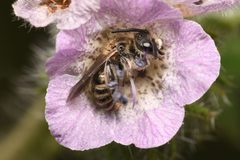
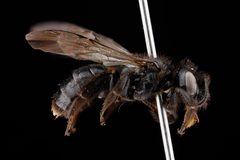
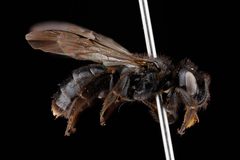
Dufourea is a of sweat bees in the Halictidae, containing at least 160 described . These solitary bees are characterized by their distinctive facial with antennal bases positioned well below the middle of the , close to the . The genus exhibits variation in pollen specialization, with some species being oligolectic on particular plant families while others show broader pollen preferences. Dufourea species occur across diverse geographic regions including North America, Europe, and alpine .
Pronunciation
How to pronounce Dufourea: //dʊˈfʊəriə//
These audio files are automatically generated. While they are not always 100% accurate, they are a good starting point.
Identification
Dufourea can be distinguished from other halictid by the low position of antennal bases on the —well below the middle and separated from the by only slightly more than the diameter of an antennal socket. The combination of short, wide clypeus and nearly as long as the clypeus further separates this genus from superficially similar . The presence of a pre-episternal groove is an additional diagnostic character.
Images
Habitat
varies by ; includes alpine regions of Central Europe, limestone bluffs and hilltop prairies, dry-mesic deciduous forests, and open glades. Some species associated with specific geological formations such as dolomite glades.
Distribution
Widespread distribution across multiple continents. Documented from North America (including eastern United States, Michigan, Illinois, and southern Arizona), Europe (including Iberian Peninsula and Alps), and other regions. Individual show more restricted ranges; for example, Dufourea lusitanica is to Iberia, while Dufourea harveyi has been recorded in Michigan and represents the first published record in the eastern United States.
Seasonality
Activity periods vary by and region. In southern Arizona, have been observed in September. In temperate regions, activity generally coincides with blooming periods of plants.
Diet
females collect pollen from flowers for provisioning nests. Degree of specialization varies among : some are oligolectic (e.g., Dufourea lusitanica and related species apparently specialized on Caryophyllaceae), while others show broader pollen host spectra.
Life Cycle
Solitary nesting . Females construct and provision nests independently without cooperative social structure.
Behavior
Solitary bees; females collect pollen and nectar to provision individual nest . Some display oligolectic , consistently visiting flowers of a single plant or for pollen collection. have been observed resting on flowers in inactive .
Ecological Role
in various including alpine and prairie . Contribution to pollination of native wildflowers, particularly in specialized plant-pollinator relationships where oligolectic are involved.
Human Relevance
Contributes to pollination of native flora. Subject of scientific research on evolution, olfactory receptor evolution, and sociality origins due to comparison with eusocial bees.
Similar Taxa
- Other Halictidae generaDufourea distinguished by low antennal base position, short wide , and pre-episternal groove; other halictids typically have antennal bases positioned higher on the
- PanurginusMorphologically similar females distinguished by quantitative characters; both occur in alpine and show variation in pollen specialization
More Details
Olfactory receptor research
Dufourea novaeangliae has been subject to genomic study revealing 112 odorant receptors, providing comparative data for understanding evolution of olfaction in solitary versus eusocial bees
Subgeneric classification
Subgenus Dentirophites occurs in Iberia, containing with specialized plant associations
Sources and further reading
- BugGuide
- Wikipedia
- iNaturalist taxon
- NCBI Taxonomy
- Catalogue of Life
- Lepidoptera | Beetles In The Bush | Page 4
- Dufourea ( Dentirophites) in Iberia, with first records of a pollen host for Dufourea lusitanica Ebmer, 1999 (Hymenoptera: Apoidea, Halictidae)
- Bees of the genera <i>Dufourea</i> and <i>Dieunomia</i> of Michigan (Hymenoptera: Apoidea: Halictidae), with a key to the <i>Dufourea</i> of the eastern United States
- Pollen host selection by predominantly alpine bee species of the genera Andrena, Panurginus, Dufourea, Megachile, Hoplitis and Osmia (Hymenoptera, Apoidea)
- <i>Dufourea Novaeangliae</i> in Illinois, with Confirmation of Host Plant (Hymenptera: Halictidae)
- Computational genome-wide survey of odorant receptors from two solitary bees Dufourea novaeangliae (Hymenoptera: Halictidae) and Habropoda laboriosa (Hymenoptera: Apidae)