
Sphecodes ranunculi
Robertson, 1897
Blood Bee
Sphecodes ranunculi is a of cleptoparasitic sweat bee in the Halictidae, first described by Robertson in 1897. As a member of the Sphecodes, commonly known as "blood bees" for their typically red and black coloration, this species exhibits the cuckoo-like reproductive strategy characteristic of the genus: females invade nests of other solitary bees to lay in chambers. The parasitic larvae consume the host's pollen provisions and prey upon the host's developing young.
Pronunciation
How to pronounce Sphecodes ranunculi: /ˈsfɛkoʊdiːz rəˈnʊŋkjʊlaɪ/
These audio files are automatically generated. While they are not always 100% accurate, they are a good starting point.
Identification
Identification to level requires examination of microscopic morphological characters, particularly male genitalia and female facial markings. Distinguished from other Sphecodes species by subtle structural features of the , propodeum, and genital capsule. Separated from non-parasitic Halictidae by the combination of: slender , reduced scopa, and typically red-and-black coloration. Distinguished from other cleptoparasitic bees (Nomada, Triepeolus, Coelioxys) by -level characters including wing venation and subantennal .
Images
Appearance
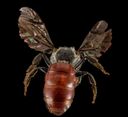
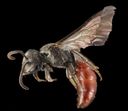
Typical Sphecodes : slender body with constricted waist ( ), often with red and black coloration giving the "blood bee." Most Sphecodes have reduced or absent scopal hairs for pollen collection since they do not provision their own nests. Wing venation reduced compared to non-parasitic halictids. Specific diagnostic features for S. ranunculi require expert examination.
Habitat
Associated with nesting of sweat bees (Halictidae), particularly ground-nesting . Found in open, sunny areas with suitable soil substrates for host nesting, including meadows, grasslands, and disturbed ground. Specific microhabitat preferences documented for Vermont .
Distribution
North America; recorded from Vermont, United States. Distribution details otherwise poorly documented in available sources.
Host Associations
- Halictidae - Cleptoparasitic on other sweat bees; specific for S. ranunculi not documented in available sources
Life Cycle
As a , females do not construct nests or collect pollen. are deposited in ; larvae consume host provisions and kill host larvae. Developmental timing synchronized with host .
Behavior
Females exhibit nest-searching , hovering low over ground to locate burrows. Upon locating an unguarded host nest, females enter to deposit in . Some Sphecodes reportedly use force to enter defended nests, killing opposition and expelling them from the entrance.
Ecological Role
Acts as a control agent for sweat bee . As a , contributes to regulation within . visitation of flowers for nectar may provide minor pollination services, though this is incidental to their reproductive strategy.
Human Relevance
No direct economic significance. Contributes to biodiversity of native . Presence indicates healthy of sweat bee and intact ground-nesting bee .
Similar Taxa
- NomadaAlso cleptoparasitic bees with -like appearance; distinguished by -level characters (Apidae vs. Halictidae) including wing venation and presence of jugal lobe in forewing
- TriepeolusCleptoparasitic bees in tribe Epeolini (Apidae); similar cuckoo but larger size, different wing venation, and associations primarily with Centris and other Apidae
- CoelioxysCleptoparasitic leafcutter bees (Megachilidae); distinguished by pointed adapted for penetrating sealed leaf-cutter nests, different associations
- Non-parasitic HalictidaeLack , possess well-developed scopal hairs for pollen collection, exhibit nest-provisioning
More Details
Taxonomic Note
The specific epithet 'ranunculi' likely refers to association with buttercup flowers (Ranunculus) for nectar feeding, though this has not been explicitly documented in available literature.
Sources and further reading
- BugGuide
- Wikipedia
- GBIF taxonomy match
- iNaturalist taxon
- NCBI Taxonomy
- Catalogue of Life
- The Native Bees in the UC Davis Bee Haven | Bug Squad
- Cuckoo! Cuckoo! Cuckoo! | Bug Squad
- Not-so Solitary Bees - Buglife Blog - Buglife
- From Bugs to Brains.…and….From Green Spaces to Better Mental Well-Being - Buglife Blog - Buglife