
Lasioglossum vierecki
(Crawford, 1904)
Viereck's Sweat Bee
Lasioglossum vierecki is a solitary sweat bee in the Halictidae, commonly known as Viereck's Sweat Bee. It is a sand , nesting exclusively in sandy soils and visiting plants restricted to sandy . The is distinguished by its densely hairy orange-yellow with golden-yellow hair on the scutellum and extensively yellow legs in females. Active from April to September, it occurs across eastern North America from Minnesota and southern Canada to Georgia and Louisiana.
Pronunciation
How to pronounce Lasioglossum vierecki: //ˌlæsi.oʊˈɡlɒsəm viˈɛrəki//
These audio files are automatically generated. While they are not always 100% accurate, they are a good starting point.
Identification
Distinguished from similarly colored bees by: golden-yellow hair on scutellum with pits touching it; darker on bottom half; rugae reaching top of with narrowly spaced punctures; non-bronze, non-shiny with punctures; unpolished with small punctures; bluer first abdominal segment. Females identified by extensively yellow legs with brown-tinted and dense yellow tomentum. Males identified by smaller size and numerous scutal punctures.
Images
Appearance
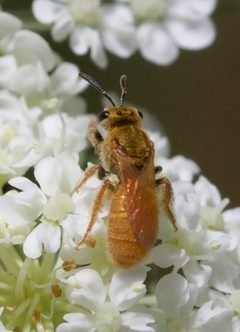
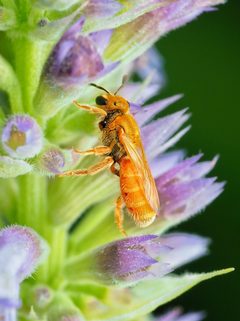
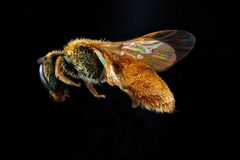
Medium-sized sweat bee with extremely hairy, orange-yellow . Scutellum has clear golden-yellow hair, with pits touching the scutellum. darker on bottom half. same color as abdomen, not smooth or polished in middle, with small punctures. Abdomen lacks bronze-colored reflection and is not smooth and shiny, though punctured. First abdominal segment bluer than other segments with distinct punctures. Legs lighter but not polished. Rugae on reaches top, with narrowly spaced punctures.
Habitat
Sand restricted to sandy areas. Nests in sand and visits plants associated with sandy soils. Found in sandy riverbanks, sand pits, and other sandy .
Distribution
Eastern North America: from Minnesota east through New England states, south to Georgia and Louisiana. In Canada: Manitoba and Ontario.
Seasonality
Active April through September.
Diet
. Recorded visiting flowers including grass-leaved goldenrod (Euthamia graminifolia), rattlesnake master (Eryngium yuccifolium), Ceanothus, Hydrangea, Rubus, Specularia, Helianthus, Monarda, and Solidago.
Life Cycle
Solitary : single female raises entire alone in individual nest. Female excavates burrow in sand, provisions each with pollen and nectar, seals cell, and lays another egg. Once tunnel is filled, it is plugged with soil and another tunnel is dug.
Behavior
Exhibits solitary nesting . Females forage alone and provision nests without assistance. Males emerge earlier and patrol nesting areas seeking females. Active during warm months, with visiting flowers for pollen and nectar.
Ecological Role
of native plants in sandy . As a sand , contributes to pollination services in where other bees may be less abundant. Part of native that provide crop pollination services in agricultural landscapes.
Human Relevance
Native of increasing importance for agriculture due to declines in managed . Conservation efforts include planting native plants such as grass-leaved goldenrod and rattlesnake master to sustain populations.
Similar Taxa
- Lasioglossum gundlachiiClose relative within subgenus Dialictus; distinguished by morphological differences in punctation and hair
- Lasioglossum umbripenneClose relative within subgenus Dialictus; L. vierecki distinguished by orange-yellow with golden scutellar hair
- Lasioglossum parvumClose relative within subgenus Dialictus; L. vierecki is larger with distinct abdominal coloration
- Lasioglossum tegulareClose relative within subgenus Dialictus; distinguished by morphological characters of and abdominal punctation
More Details
Taxonomic History
Originally described as Halictus vierecki by Crawford in 1904. Later transferred to Lasioglossum and subgenus Dialictus. Has been treated under three generic names reflecting changing understanding of halictid .
Sand Specialization
As a sand (psammophile), L. vierecki demonstrates narrow fidelity. This specialization makes vulnerable to habitat loss from sand mining, development, and of sandy areas to other vegetation types.
Research Significance
Like many Lasioglossum , L. vierecki is frequently captured in bowl trap surveys, contributing to discussions about monitoring methodology. The Lasioglossum is the largest bee genus with over 1,700 species, making species-level identification challenging and requiring expert taxonomic skills.
Sources and further reading
- BugGuide
- Wikipedia
- GBIF taxonomy match
- iNaturalist taxon
- NCBI Taxonomy
- Catalogue of Life
- Just inTime for Pollinator Week | Bug Squad
- Bug Eric: Don't Sweat 'em
- Back-Seat Driver: The Parasite That Makes Bees Drop Off Its Babies
- Building a Better Bee Trap: Researchers Say Bee Bowls Are Overused
- Bug Eric: White Prairie Clover: An Awesome Blossom
- Not-so Solitary Bees - Buglife Blog - Buglife