
Lasioglossum pilosum
(Smith, 1853)
sweat bee
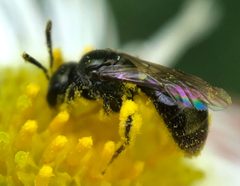
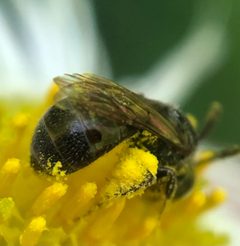
Lasioglossum pilosum is a of sweat bee in the Halictidae, described by Smith in 1853. It is a known to visit flowers of diverse plant species and has been documented pollinating commercial fruit crops including apples. The species is native to North America, with confirmed records from the northeastern United States including Vermont. Like other halictid bees, it exhibits the characteristic of lapping human perspiration for salts and minerals. Females possess a sting that has been described as mildly irritating relative to other stinging bees.

Pronunciation
How to pronounce Lasioglossum pilosum: /ˌlæsi.oʊˈɡlɒsəm pɪˈloʊsəm/
These audio files are automatically generated. While they are not always 100% accurate, they are a good starting point.
Images
Distribution
North America; confirmed present in Vermont, United States. GBIF records indicate presence in the northeastern United States.
Diet
floral visitor; has been observed pollinating flowers and commercial fruits including apples. have been documented lapping human perspiration for salts and minerals.
Behavior
Females are known to sting when threatened, though the sting is described as mild compared to other stinging . Both sexes have been observed visiting flowers for nectar and pollen.
Ecological Role
of wild flowers and commercial fruit crops.
Human Relevance
Documented of commercial apple crops. May deliver a mild sting if handled roughly or trapped against skin. Attracted to human perspiration, which it laps for salts and minerals.
Similar Taxa
- Lasioglossum (Dialictus) speciesNumerous small, often metallic Lasioglossum in the subgenus Dialictus are frequently captured in bowl traps and may be confused with L. pilosum without close examination; L. pilosum is distinguished by specific pilosity and morphological characters described in the original species .
- Halictus rubicundusAnother halictid sweat bee that shares the general habit of lapping human perspiration, but differs in being medium-sized with brown or blackish coloration and white bands across the , whereas L. pilosum is described as pilose (hairy).
- Agapostemon speciesBrilliant metallic green sweat bees that share the 'sweat bee' and perspiration-lapping , but are readily distinguished by their striking metallic coloration not characteristic of L. pilosum.
More Details
Research bias in sampling
Lasioglossum , including L. pilosum, are frequently overrepresented in bowl trap relative to their abundance on flowers, potentially skewing diversity estimates in monitoring studies.
Sting characteristics
While described as 'mild' in comparison to other stinging bees, individual reactions to L. pilosum stings may vary considerably; at least one report describes a severe local reaction with significant pain and swelling lasting multiple days.
Sources and further reading
- BugGuide
- Wikipedia
- GBIF taxonomy match
- iNaturalist taxon
- NCBI Taxonomy
- Catalogue of Life
- Just inTime for Pollinator Week | Bug Squad
- Bug Eric: Don't Sweat 'em
- Back-Seat Driver: The Parasite That Makes Bees Drop Off Its Babies
- Building a Better Bee Trap: Researchers Say Bee Bowls Are Overused
- Bug Eric: White Prairie Clover: An Awesome Blossom
- Not-so Solitary Bees - Buglife Blog - Buglife