
Halictus farinosus
Smith, 1853
Wide-striped Sweat Bee
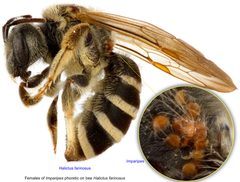
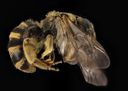
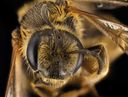
Halictus farinosus is a primitively eusocial sweat bee native to North America. It nests underground in soil, forming small colonies averaging 3.5 and 13.5 reproductive . The exhibits intermediate social strength within the Halictus, with most workers mated and capable of ovarian development. Nesting varies with weather conditions, with colder, wetter springs delaying activity by up to two weeks.
Pronunciation
How to pronounce Halictus farinosus: /həˈlɪktəs fəˈrɪnoʊsəs/
These audio files are automatically generated. While they are not always 100% accurate, they are a good starting point.
Images
Habitat
Ground-nesting in soil, often in . Documented nesting sites include Green Canyon, Utah. Requires bare or sparsely vegetated soil for nest excavation.
Distribution
North America. Documented studied in northern Utah (Green Canyon). GBIF records indicate presence across North America.
Seasonality
Nesting activity occurs May to August. Phenological timing varies with spring weather conditions; colder, wetter springs delay nesting by up to two weeks.
Life Cycle
Primitively eusocial with small colonies. Colonies contain a and , averaging 3.5 workers and 13.5 reproductive per colony. Most workers are mated (77.5%) and exhibit ovarian development (73.4%). Queen-worker size differential is moderate (8.8% width, 6.2% wing length).
Behavior
Nesting is delayed by up to two weeks in colder, wetter spring conditions. - size differential varies annually with weather, being larger in colder years. Workers in favorable conditions survive at greater rates, grow larger, and may produce their own offspring.
More Details
Social Structure Variability
The demonstrates plasticity in social parameters based on environmental conditions. Weather affects not only but also the degree of - differentiation, with colder years producing more pronounced size differences between .
Research History
Long-term studies at Green Canyon, Utah have tracked this across multiple decades (1977/1978, 2002, 2010), providing rare comparative data on how climate variation affects social .
Sources and further reading
- BugGuide
- Wikipedia
- GBIF taxonomy match
- iNaturalist taxon
- NCBI Taxonomy
- Catalogue of Life
- Going Native: Do You Know the Native Bees of California? | Bug Squad
- 'Am I Even a Bee?' Identity Crisis Unfolds in This Charming Book | Bug Squad
- Are Honeybees the Most Effective Pollinators? | Bug Squad
- 'Bee' One in a Million | Bug Squad
- Sweet times for sweat bees: Sweat bees, Halictus ligatus and Agapostemon virescens — Bug of the Week
- Ground nesting bees, beware the bee fly: Bombyliidae — Bug of the Week
- Notes on the biology of Halictus (Halictus) Farinosus Smith (Hymenoptera: Halictidae) /
- Nesting biology and phenology of a population of Halictus farinosus Smith (Hymenoptera, Halictidae) in northern Utah
- Figure 5 from: Albert J, Packer L (2013) Nesting biology and phenology of a population of Halictus farinosus Smith (Hymenoptera, Halictidae) in northern Utah. Journal of Hymenoptera Research 32: 55-73. https://doi.org/10.3897/jhr.32.4646
- Figure 4 from: Albert J, Packer L (2013) Nesting biology and phenology of a population of Halictus farinosus Smith (Hymenoptera, Halictidae) in northern Utah. Journal of Hymenoptera Research 32: 55-73. https://doi.org/10.3897/jhr.32.4646
- Figure 3 from: Albert J, Packer L (2013) Nesting biology and phenology of a population of Halictus farinosus Smith (Hymenoptera, Halictidae) in northern Utah. Journal of Hymenoptera Research 32: 55-73. https://doi.org/10.3897/jhr.32.4646
- Figure 1 from: Albert J, Packer L (2013) Nesting biology and phenology of a population of Halictus farinosus Smith (Hymenoptera, Halictidae) in northern Utah. Journal of Hymenoptera Research 32: 55-73. https://doi.org/10.3897/jhr.32.4646
- Figure 2 from: Albert J, Packer L (2013) Nesting biology and phenology of a population of Halictus farinosus Smith (Hymenoptera, Halictidae) in northern Utah. Journal of Hymenoptera Research 32: 55-73. https://doi.org/10.3897/jhr.32.4646