
Agapostemon virescens
(Fabricius, 1775)
Bicolored Striped Sweat Bee, bicolored striped-sweat bee
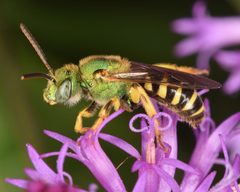
Agapostemon virescens, commonly known as the bicolored striped sweat bee, is a metallic green halictid native to North America. It is the official bee of Toronto, Canada. Females nest underground, often forming where multiple females share a single burrow entrance, though the is considered solitary rather than truly social. The species exhibits in coloration and is a frequently observed on flowers.
Pronunciation
How to pronounce Agapostemon virescens: /ˌæɡəˈpɑstɪmən vɪˈrɛsɛnz/
These audio files are automatically generated. While they are not always 100% accurate, they are a good starting point.
Identification
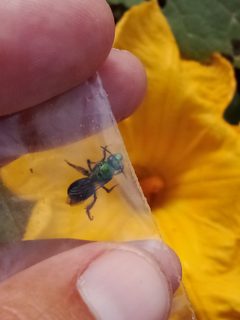
Distinguished from other metallic green halictids by the bicolored pattern: metallic green and with contrasting non-metallic, banded . Females of most other Agapostemon are wholly metallic green. Distinguished from cuckoo wasps (often mistaken for metallic bees) by —A. virescens is commonly found on flowers, flies and alights directly rather than with jerky movements, and females carry pollen on hind legs.
Images
Habitat
Open areas with loamy soils and sparse vegetation suitable for underground nesting. Often found in gardens, meadows, and urban green spaces. Nests in sunny spots with thin lawn cover or bare ground patches.
Distribution
North America. Documented from Canada (including Ontario, where it is the official of Toronto) through the United States. Specific state records include Vermont.
Seasonality
Active during warm months, with nesting forming in spring. observed from spring through summer, with timing varying by latitude.
Diet
. Collects nectar and pollen from diverse flowering plants. Observed frequently on Asteraceae members including Echinacea (coneflowers). may also imbibe salt-rich perspiration from humans.
Life Cycle
Solitary nesting in underground burrows. Females excavate burrows in soil, with individual nests containing more than 100 . Multiple females may share a single nest entrance, forming , though nests function independently. Development includes , larval, and pupal stages within brood cells provisioned with pollen and nectar.
Behavior
Females forage for pollen and nectar, storing pollen in scopae on hind legs. Nesting females may act as guards at shared nest entrances. Males perch on leaves and stems to watch for passing females. Forms nesting where multiple females share burrow entrances. Not truly social—no or cooperative care.
Ecological Role
contributing to pollination of native plants and agricultural crops. Part of native in agricultural and urban .
Human Relevance
Official of Toronto, Canada. Valued as a native in gardens and urban green spaces. Attracted to Echinacea and other garden flowers. Occasionally alights on human skin to collect perspiration, giving 'sweat bee' —generally harmless.
Similar Taxa
- Other Agapostemon speciesMost other in have wholly metallic green females; A. virescens uniquely has black with white hair bands in females
- Augochlorini tribe bees (Augochlora, Augochlorella, Augochloropsis)Virtually identical bright metallic green coloration; require microscopic examination to distinguish; all are bright metallic green without contrasting abdominal banding
- Cuckoo wasps (family Chrysididae)Similar metallic green appearance but lack pollen-carrying structures, exhibit jerky rapid movements, and are seldom found on flowers
More Details
Social organization note
While A. virescens forms nest with shared entrances, this is communal nesting rather than true sociality. Each female provisions her own independently; there are no or cooperative brood care.
Nesting site preference
Favors loamy soils with sparse vegetation; large can form where conditions are favorable. Gardeners can encourage by allowing sunny lawn areas to go thin or bare.
Sources and further reading
- BugGuide
- Wikipedia
- GBIF taxonomy match
- iNaturalist taxon
- NCBI Taxonomy
- Catalogue of Life
- The Native Bees in the UC Davis Bee Haven | Bug Squad
- Sweet times for sweat bees: Sweat bees, Halictus ligatus and Agapostemon virescens — Bug of the Week
- Bug Eric: Metallica
- Estimating Bee Communities is a Tall Task, Analysis Shows
- Life at 8X—Guide to lepidopteran eggs on soybean | Beetles In The Bush
- Tabloid Sensationalism Aside, Lady Bugs Are Still Fascinating