
Agapostemon tyleri
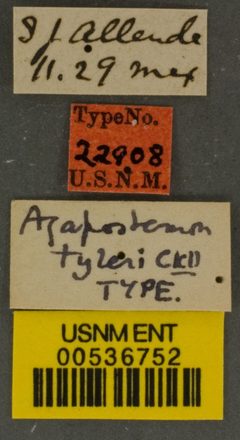
Cockerell, 1917
Tyler's Striped Sweat Bee
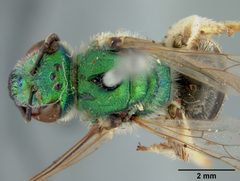
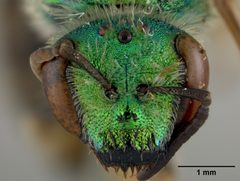
Agapostemon tyleri is a of sweat bee in the Halictidae, first described by Cockerell in 1917. It belongs to a known for metallic green coloration and ground-nesting . The species occurs in North America and Middle America, though specific ecological details remain poorly documented compared to better-studied such as A. virescens and A. texanus.
Pronunciation
How to pronounce Agapostemon tyleri: /ˌæɡəˈpɒstɛmən ˈtaɪləri/
These audio files are automatically generated. While they are not always 100% accurate, they are a good starting point.
Identification
Reliable identification of A. tyleri requires examination of diagnostic morphological features, as the closely resembles other Agapostemon species. Females of most Agapostemon species are wholly metallic green and relatively hairy, while males have metallic green and with a black and yellow banded . Specific characters distinguishing A. tyleri from are not documented in the provided sources. Microscopic examination by a is likely necessary for confident identification.
Images
Distribution
North America; Middle America. GBIF records indicate presence in both regions, though precise range boundaries are not established.
Ecological Role
As a member of Halictidae, A. tyleri likely functions as a of flowering plants, as is characteristic of the . The Agapostemon includes foragers that visit diverse floral resources.
Similar Taxa
- Agapostemon virescensFemales of A. virescens have a black with bands of white hairs, differing from the wholly metallic green females of most other Agapostemon . A. tyleri females are likely wholly metallic green based on patterns, but this requires verification.
- Agapostemon texanusA widespread and commonly observed in western North America, frequently documented in California gardens. Males have similar banded abdominal coloration. Specific distinguishing features from A. tyleri are not detailed in available sources.
- Augochlora, Augochlorella, Augochloropsis speciesThese Augochlorini tribe members are virtually identical in appearance to Agapostemon, all being bright metallic green or blue-green. Microscopic examination is required to distinguish .
- Cuckoo wasps (Chrysididae)Frequently mistaken for metallic green sweat bees due to similar coloration. Cuckoo wasps can be distinguished by : they are seldom found on flowers, flit about with quick jerky movements, and do not collect pollen. Sweat bees are common on flowers, move more directly, and females carry pollen on hind leg scopae.
More Details
Taxonomic note
Agapostemon tyleri is one of approximately 44 in the Agapostemon, which is divided into two subgenera. The genus is part of the diverse Halictidae , commonly known as sweat bees due to some species' attraction to human perspiration for moisture and salts.
Data limitations
This has only 7 observations recorded on iNaturalist as of the source date, indicating it is rarely encountered or underreported compared to . Most ecological information about Agapostemon derives from studies of A. virescens and A. texanus; direct observations of A. tyleri , nesting , and floral associations are not available in the provided sources.
Sources and further reading
- BugGuide
- Wikipedia
- GBIF taxonomy match
- iNaturalist taxon
- NCBI Taxonomy
- Catalogue of Life
- California Has No State Bee--Yet! | Bug Squad
- The Native Bees in the UC Davis Bee Haven | Bug Squad
- Going Native: Do You Know the Native Bees of California? | Bug Squad
- Attracting Pollinators to Your Garden | Bug Squad
- Sweet times for sweat bees: Sweat bees, Halictus ligatus and Agapostemon virescens — Bug of the Week
- Bug Eric: Metallica