
Agapostemon angelicus
Cockerell, 1924
Angeles Striped Sweat Bee, Angeles striped-sweat bee
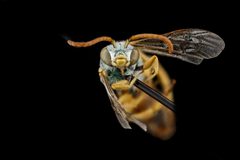
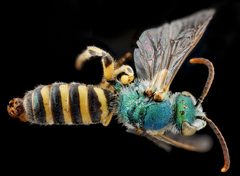
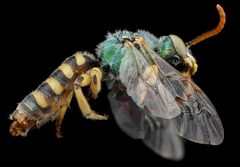
Agapostemon angelicus, the Angeles Striped Sweat Bee, is a small halictid native to western North America. Females are entirely metallic green, while males have a yellow-and-black banded . The is a and ground-nesting solitary bee, commonly found in desert and semi-arid regions of the southwestern United States.
Pronunciation
How to pronounce Agapostemon angelicus: /ˌæɡəˈpɒstɛmən ænˈdʒɛlɪkəs/
These audio files are automatically generated. While they are not always 100% accurate, they are a good starting point.
Identification
Females are distinguished from similar Agapostemon by their entirely metallic green body, lacking pale abdominal bands. Males are distinguished from other Agapostemon males by specific banding patterns and geographic distribution. A. angelicus is most easily confused with A. texanus; precise identification may require examination of subtle morphological characters. Cuckoo wasps (Chrysididae) can be mistaken for female A. angelicus due to shared metallic coloration, but lack pollen-collecting scopae on hind legs and exhibit quick, jerky movements compared to the more deliberate of bees.
Images
Habitat
Found in desert and semi-arid regions, particularly in and around the southwestern United States. Nests are constructed in soil, often in areas with sparse vegetation. Favors sunny, open ground with suitable soil substrate for tunnel excavation.
Distribution
North America, from Canada south to Mexico. Most commonly found in the western and central United States, with highest abundance in desert regions of the southwestern US.
Seasonality
Primarily active during daylight hours. have been observed taking on larger flowers during the night. Activity period spans warm months, with specific varying by locality.
Diet
Polylectic , feeding on nectar and pollen from diverse flowering plants. Specific floral associations include members of Asteraceae such as Echinacea (coneflowers).
Life Cycle
Ground-nesting solitary . Females excavate tunnels in soil to serve as nests. are provisioned with pollen balls rather than honey. are laid on pollen provisions for larvae to consume. Two recognized: A. angelicus angelicus and A. angelicus idahoensis.
Behavior
Females are primarily solitary, though the degree of sociality varies within the . Males may aggregate on single plants. Attracted to human sweat for salt content, though males appear less likely to exhibit this than females. Generally docile; females capable of stinging but rarely aggressive. Preening behavior observed, with individuals resting on sunlit leaves.
Ecological Role
Human Relevance
Provides pollination services in natural and garden settings. Attraction to human sweat can result in close encounters, but stings are rare and mild. Valued as a native in restoration and pollinator gardening initiatives.
Similar Taxa
- Agapostemon texanusOverlapping distribution and similar size; females also metallic green but may differ in subtle morphological characters
- Agapostemon virescensShared metallic green female coloration; A. virescens females have black with white hair bands, not entirely green
- Chrysididae (cuckoo wasps)Similar metallic green coloration; distinguished by lack of pollen-collecting structures and different
Misconceptions
The 'sweat bee' is sometimes misunderstood to mean these bees produce sweat; rather, they are attracted to human perspiration for its salt content. The is sometimes mistaken for A. texanus due to similarity in appearance and distribution.
More Details
Taxonomic history
Described by Cockerell in 1924. Two currently recognized: the nominate A. angelicus angelicus and A. angelicus idahoensis.
Nesting biology
Communal nesting has been observed in related Agapostemon , but whether A. angelicus females share nest entrances remains unclear from available observations.
Sources and further reading
- BugGuide
- Wikipedia
- GBIF taxonomy match
- iNaturalist taxon
- NCBI Taxonomy
- Catalogue of Life
- California Has No State Bee--Yet! | Bug Squad
- The Native Bees in the UC Davis Bee Haven | Bug Squad
- Encyrtid Holdings | Entomology Research Museum
- Going Native: Do You Know the Native Bees of California? | Bug Squad
- Sweet times for sweat bees: Sweat bees, Halictus ligatus and Agapostemon virescens — Bug of the Week
- Bug Eric: Metallica