
Pseudaugochlora graminea
(Fabricius, 1804)
Grassy Green-Sweat Bee
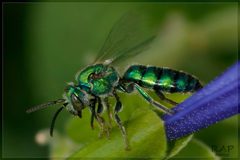
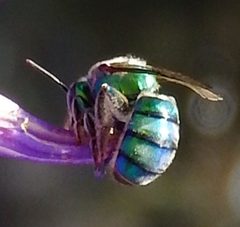
Pseudaugochlora graminea is a of sweat bee in the Halictidae, distributed across the Neotropics from Mexico through Central America to South America. As a member of the tribe Augochlorini, it exhibits the metallic green coloration typical of this group. The species has been documented in 613 iNaturalist observations, indicating it is relatively well-observed within its range.
Pronunciation
How to pronounce Pseudaugochlora graminea: //ˌsjuːdɔːɡəˈklɔːrə ɡræˈmɪniə//
These audio files are automatically generated. While they are not always 100% accurate, they are a good starting point.
Identification
Distinguished from other Augochlorini by subtle morphological features of the male genitalia and other diagnostic characters used in the Pseudaugochlora. The genus Pseudaugochlora was established based on distinct genitalic separating it from the closely related Augochlora. Identification to level typically requires examination of microscopic features.
Images
Appearance
Exhibits metallic green coloration characteristic of the Augochlorini tribe. As with other members of Halictidae, it has a compact body form with branched hairs covering much of the body. The specific epithet 'graminea' (Latin for 'grassy') may allude to coloration or association, though this has not been explicitly documented.
Distribution
Mexico, Central America ( Rica, Panama), and South America (Colombia, Venezuela, French Guiana, Peru, Brazil, Paraguay, Argentina). Records indicate presence across a broad Neotropical range.
Ecological Role
As a halictid , likely functions as a within its range, though specific plant associations have not been documented.
Similar Taxa
- Augochlora speciesFormerly included in Augochlora; separated based on male genitalic and other structural differences
- Other Pseudaugochlora speciesRequires detailed examination of genitalia and other microscopic features for reliable separation
More Details
Taxonomic History
Originally described by Fabricius in 1804. The Pseudaugochlora was subsequently established to accommodate previously placed in Augochlora that exhibit distinct morphological characteristics, particularly in male genitalia structure.
Observation Data
With 613 iNaturalist observations, this is among the more frequently documented members of its , suggesting it is either common, widespread, or both within its Neotropical range.