
Solenopsis amblychila
Wheeler, 1915
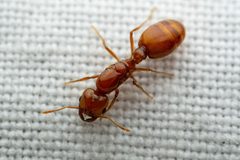
Solenopsis amblychila is a native North American fire in the Solenopsis, first described by Wheeler in 1915. It is restricted to the southwestern United States and is distinguished from other fire ants by its pale golden-yellow coloration. The species is notable for its ability to persist in arid environments, though it also occupies irrigated . exhibit with distinct major and minor worker .


Pronunciation
How to pronounce Solenopsis amblychila: //ˌsoʊlɪˈnɒpsɪs ˌæmblɪˈkaɪlə//
These audio files are automatically generated. While they are not always 100% accurate, they are a good starting point.
Identification
Distinguished from other Solenopsis by its pale golden-yellow coloration. Most commonly confused with Solenopsis aurea, which shares similar golden coloration; accurate identification requires examination of morphological characters beyond color alone. The polymorphic (presence of both major and minor workers) is a useful diagnostic feature for the , though not unique to this species.
Images
Appearance
are pale golden to yellow in coloration. The exhibits , with colonies containing both major workers (larger, with disproportionately large ) and minor workers (smaller, more gracile).
Habitat
Occurs in arid and semi-arid environments, including very dry conditions. Also found in well-watered lawns and irrigated areas. Nests in soil, under rocks, or beneath pieces of wood.
Distribution
Native to the southwestern United States.
Life Cycle
Colonies contain polymorphic with both major and minor . No further details on stages are documented in available sources.
Similar Taxa
- Solenopsis aureaShares similar golden coloration, leading to frequent misidentification
- Solenopsis invictaConvergent general body plan and polymorphic , though S. invicta is reddish-brown to dark rather than golden-yellow
More Details
Nomenclature
Authored by Wheeler, 1915. The specific epithet 'amblychila' derives from Greek roots, with 'amblys' meaning blunt or obtuse and 'cheilos' meaning lip, likely referring to a morphological feature of the or .
Sources and further reading
- BugGuide
- Wikipedia
- GBIF taxonomy match
- iNaturalist taxon
- NCBI Taxonomy
- Catalogue of Life
- Oh, oh, oh, I'm on fire - Red Imported fire ant, Solenopsis invicata — Bug of the Week
- In a warming world, here comes the red imported fire ant, Solenopsis invicata — Bug of the Week
- Fire ant winged reproductives: male and female | Beetles In The Bush
- How Entomologists are Battling Invasive Ants to Protect a Texas Cave Ecosystem
- Non-Repellent Insecticide Prevents Fire Ant Infestations in Nursery Plant Root Balls
- How Ticks Hide in Plain Sight From Predatory Fire Ants