
Tetramorium bicarinatum
(Nylander, 1846)
ghost ant, bicarinatum-group fierce ant
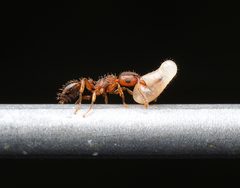
Tetramorium bicarinatum is a widely distributed native to Southeast Asia that has become established globally as a common tramp species. It is frequently found in human-modified environments including houses, greenhouses, and landscaped areas. The species forms mutualistic relationships with honeydew-producing insects such as , particularly tending the cotton mealybug Phenacoccus solenopsis on agricultural crops. Its venom contains pharmacologically active , including the helix ring peptide Tb11a (bicarinalin), which has attracted research interest for potential biomedical applications.
Pronunciation
How to pronounce Tetramorium bicarinatum: //ˌtɛtrəˈmɔːriəmˌbaɪˌkærɪˈneɪtəm//
These audio files are automatically generated. While they are not always 100% accurate, they are a good starting point.
Identification
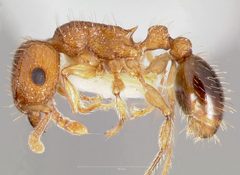
Distinguished from similar Tetramorium by the bicarinate (two-keeled) propodeum and the characteristic color pattern of reddish /mesosoma contrasting with dark . In the field, it may be confused with other tramp ant species but can be separated by its specific morphological features and nesting habits in human structures.
Images
Habitat
Human-modified environments including inside houses, greenhouses, shade houses, and landscaped areas near buildings. Agricultural settings, particularly cotton fields where it tends . Colonizes newly disturbed and early successional environments.
Distribution
Native to Southeast Asia; now one of the most widely distributed globally. Established as an tramp species across Europe, Africa, the Americas, Australia, and Pacific islands including the Galápagos and Azores (Corvo, Faial, São Miguel, Santa Maria).
Diet
Collects honeydew from tended (Phenacoccus solenopsis); likely also consumes other sugary substances and small prey items, though specific dietary breadth beyond mealybug mutualism is not well documented.
Host Associations
- Phenacoccus solenopsis - mutualismTends cotton for honeydew; does not distinguish between volatiles from mealybug-only versus -tended mealybug plants
Behavior
Forms mutualisms with honeydew-producing insects; does not recruit to mealybug-damaged plants when physical contact with is prevented. Shows rapid and substantial recruitment to mechanically damaged plants (simulating chewing herbivore damage), likely due to increased extrafloral secretions. Patrolling ants are not attracted to plants with -tended mealybugs without direct contact.
Ecological Role
engineer through soil aeration and organic matter decomposition. Mutualist with honeydew-producing insects that alters plant volatile emissions: -tended increase methyl salicylate and decrease methyl nicotinate compared to untended mealybugs. This volatile modification indirectly affects third-party interactions by increasing attraction of experienced (Aenasius bambawalei) to plants. Considered a potential threat to native biodiversity where introduced.
Human Relevance
Common household pest in tropical and subtropical regions. Potential biocontrol agent through its role in tending that attract . Source of pharmacologically active venom compounds including bicarinalin (Tb11a), an antibacterial and antimicrobial with potential for drug development against - . Subject of biomedical research due to unique venom peptides.
Similar Taxa
- Tetramorium caespitumSimilar and general appearance; T. caespitum is a pavement ant with different coloration (typically uniform dark brown to blackish) and propodeal structure, and is native to Europe rather than Southeast Asia
- Plagiolepis alluaudiSimilar size and tramp ant ; P. alluaudi is smaller (<2mm), uniformly yellow, and native to Madagascar rather than showing the two-toned coloration of T. bicarinatum
- Wasmannia auropunctataSimilar small size and tramp ant status; W. auropunctata has a distinctive stinger and different body proportions, and is known for painful stings unlike T. bicarinatum
More Details
Venom biochemistry
The venom contains the helix ring Tb11a (also known as U11, MYRTXA4-Tb11a, or bicarinalin). Research has debated whether this peptide functions as a Kv1.3 potassium channel blocker or as a pore-forming toxin; current evidence suggests it may have cytotoxic/pore-forming activity at higher concentrations while showing channel-blocking potential in specific contexts. The peptide's oxidized form with intact disulfide bridge appears necessary for specific bioactivity.
Invasion history
Long considered a separate from its Asian counterpart until genetic and distributional analyses confirmed them as the same widespread supertramp species. Its global spread has been facilitated by human commerce, particularly through shipments of plants and agricultural products.
Sources and further reading
- BugGuide
- Wikipedia
- GBIF taxonomy match
- iNaturalist taxon
- NCBI Taxonomy
- Catalogue of Life
- During Quarantine, an Entomologist Takes a Closer Look at a New Invasive Ant Species
- alien | Blog
- Orchids and ants, early invaders of lava flows: Bamboo orchid, Arundina graminifolia and an unidentified ant, Formicidae sp. — Bug of the Week
- Tetramorium caespitum ant - Entomology Today
- Bug Eric: Predator and Prey: Ants versus Termites
- How Ants Do Battle: Toxic Sprays, Thick Armor, Overwhelming Numbers, and More
- An ant-coccid mutualism affects the behavior of the parasitoid Aenasius bambawalei, but not that of the ghost ant Tetramorium bicarinatum
- Reply to Peigneur et al. The Helix Ring Peptide U11 from the Venom of the Ant, Tetramorium bicarinatum, Acts as a Putative Pore-Forming Toxin, Not a New Kv1.3 Channel Blocker. Comment on "Boy et al. A New Kv1.3 Channel Blocker from the Venom of the Ant Tetramorium bicarinatum. Toxins 2025, 17, 379".
- The Helix Ring Peptide U11 from the Venom of the Ant, Tetramorium bicarinatum, Acts as a Putative Pore-Forming Toxin, Not a New Kv1.3 Channel Blocker. Comment on Boy et al. A New Kv1.3 Channel Blocker from the Venom of the Ant Tetramorium bicarinatum. Toxins 2025, 17, 379.