
Crematogaster rifelna
Buren, 1968
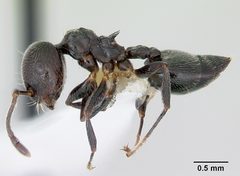
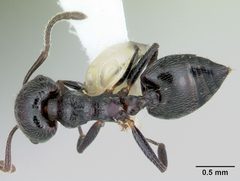
Crematogaster rifelna is a of acrobat ant in the Formicidae, described by Buren in 1968. Like other members of the Crematogaster, it possesses the characteristic -shaped () that can be raised over the when disturbed, earning the group its . The species is part of a diverse genus of ants known for their distinctive defensive postures and ecological roles as in various .
Pronunciation
How to pronounce Crematogaster rifelna: /krɛməˌtoʊˈɡæstər rɪˈfɛlnə/
These audio files are automatically generated. While they are not always 100% accurate, they are a good starting point.
Identification
Crematogaster rifelna can be distinguished from other Crematogaster by specific morphological features described in Buren's 1968 original description, though detailed diagnostic characters are not readily available in the provided sources. Members of the Crematogaster are generally recognized by their -shaped with a pointed tip, 11-segmented with a 3-segmented club, and the absence of a stinger (relying instead on chemical defenses).
Images
Distribution
The was described by Buren in 1968, suggesting a North American distribution consistent with this author's geographic focus, though specific locality data is not provided in the available sources.
Ecological Role
As a member of the Crematogaster, C. rifelna likely functions as a and scavenger in its . Related have been documented as predators of other insects, including breaking into the nests of solitary to prey on stages.
Similar Taxa
- Other Crematogaster speciesCrematogaster rifelna is morphologically similar to congeneric , requiring examination of specific diagnostic features from the original description for accurate identification.
More Details
Taxonomic history
The was formally described by William F. Buren in 1968. Buren was a prominent myrmecologist who described numerous North American species during the mid-20th century.
Sources and further reading
- BugGuide
- GBIF taxonomy match
- iNaturalist taxon
- NCBI Taxonomy
- Bug Eric: Wasp Wednesday: Polistes exclamans
- 52-million-year-old Beetle Fossil is Oldest Known Practitioner of Myrmecophily
- Bug Eric: Green Lynx Spider
- Bug Eric: Termite Swarms
- How Ants Do Battle: Toxic Sprays, Thick Armor, Overwhelming Numbers, and More
- Bug Eric: February 2011