
Strumigenys silvestrii
Emery, 1906
silvestrii-group Pygmy Snapping Ants
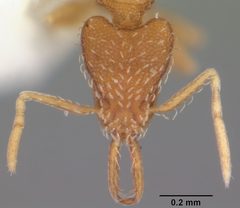
Strumigenys silvestrii is a tiny dacetine in the Strumigenys, a group known for their specialized trap-jaw . Native to South America, this has undergone significant geographic expansion, establishing across the West Indies, southern United States, and more recently in the Old World (Madeira, mainland Portugal, and Macau). It represents the only New World dacetine ant recorded in the Old World. The species exhibits a complex biogeographic pattern with records from both undisturbed forests and human-modified environments.


Pronunciation
How to pronounce Strumigenys silvestrii: /strʊˈmɪdʒəˌnɪs sɪlˈvɛstri.aɪ/
These audio files are automatically generated. While they are not always 100% accurate, they are a good starting point.
Identification
As a member of the silvestrii group, S. silvestrii can be distinguished from other Strumigenys species by morphological traits characteristic of this group. Detailed diagnostic features require examination of structure, pilosity patterns, and other microsculpture characteristics typical of dacetine ants. The species is morphologically similar to its closest relatives within the South American Strumigenys fauna.
Images
Habitat
Throughout its native and introduced ranges, S. silvestrii has been recorded from undisturbed forest , which typically indicates native status. However, many records are notably recent, suggesting ongoing range expansion. In the New World, occur in South American forests, Caribbean islands, and southern US states. Old World populations have been documented on Madeira Island, mainland Portugal, and in Macau.
Distribution
Native to South America (documented from Brazil: Bahia, Minas Gerais, Rio de Janeiro, Rio Grande do Sul, Santa Catarina, São Paulo). Expanded range includes: West Indies (Dominican Republic, Grenada, Nevis, St. Vincent), southern United States (Georgia, other southern states), and Old World localities (Madeira Island, Portugal; mainland Portugal; Macau, China). The has been documented from 67 site records across these regions.
Behavior
As a dacetine , S. silvestrii possesses specialized trap-jaw used for prey capture. This feeding apparatus is characteristic of the tribe Dacetini and represents an evolutionary for on small arthropods.
Human Relevance
S. silvestrii serves as a documented case study in and invasion dynamics. Its spread to the Old World makes it the only New World dacetine ant with established outside the Americas, providing insights into how tiny, cryptic ants can achieve transoceanic . The highlights challenges in distinguishing native range from introduced range based on associations alone.
Similar Taxa
- Other Strumigenys speciesS. silvestrii belongs to the silvestrii group, which shares derived and pilosity characteristics. Differentiation requires detailed morphological examination.
- Other Dacetini antsMembers of this tribe share convergent adaptations for small-prey , including elongated with specialized trigger hairs. S. silvestrii can be distinguished by its South American origin and specific morphological traits of the silvestrii group.
More Details
Biogeographic significance
S. silvestrii is the only New World dacetine recorded in the Old World, making its distributional pattern unique among its tribe. The combination of forest associations (suggesting native status) with very recent collection dates (suggesting recent introduction) creates an unusual biogeographic signature that complicates straightforward native/ classification.
Taxonomic history
First described by Emery in 1906, the has accumulated distributional records over more than a century, with major range expansions documented particularly in recent decades.