
Pheidole subarmata
Mayr, 1884
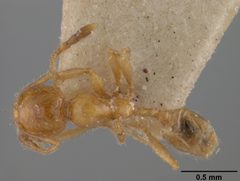
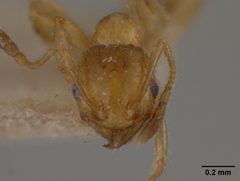
Pheidole subarmata is a of big-headed in the Pheidole, first described by Mayr in 1884. The species belongs to one of the most diverse ant genera globally, with over 1,000 described species in the New World alone. As with other Pheidole species, it exhibits a dimorphic system with minor workers and major workers (soldiers) distinguished by size. The species has been documented across South America and the Caribbean.

Pronunciation
How to pronounce Pheidole subarmata: /ˈfaɪ.doʊ.li suˈbɑːr.mə.tə/
These audio files are automatically generated. While they are not always 100% accurate, they are a good starting point.
Identification
Identification to level within Pheidole requires examination of specific morphological characters including shape, mandibular , antennal scrobe structure, and pilosity patterns. Pheidole subarmata is distinguished from through subtle morphometric differences, though precise diagnostic characters are not detailed in the provided sources. The is notorious among myrmecologists for taxonomic difficulty due to high and morphological convergence.
Images
Distribution
Documented from multiple localities in Brazil (states of Acre, Amazonas, Bahia, Minas Gerais, Mato Grosso, Pará, Piauí, Paraná, Rio de Janeiro, Rio Grande do Sul, Santa Catarina, and São Paulo) and the Dominican Republic (Santo Domingo Norte, Santo Domingo de Guzmán). The appears to be distributed across South America and into the Caribbean.
Similar Taxa
- Pheidole megacephalaAnother member of the same with similar big-headed soldier ; a globally with documented ecological impacts, whereas P. subarmata has not been reported as
- Other Pheidole speciesThe contains over 1,000 New World , many with overlapping morphological features; precise identification requires detailed examination of minute structural characters
More Details
Taxonomic Context
Pheidole is among the most -rich globally, with particularly high diversity in the Neotropics. The genus is characterized by its ecological dominance in many and its distinctive . The specific epithet 'subarmata' suggests reference to reduced or partial armature, possibly of the mesosoma or other body regions, though this interpretation is speculative without direct examination of the type material.
Research Significance
The Pheidole has become a model system for studies of determination, developmental plasticity, and invasion . While P. megacephala has been extensively studied in these contexts, most Pheidole including P. subarmata remain poorly known biologically.
Sources and further reading
- BugGuide
- GBIF taxonomy match
- iNaturalist taxon
- NCBI Taxonomy
- Catalogue of Life
- Big-headed Ants Are Biggest in Australia Due to Competition
- During Quarantine, an Entomologist Takes a Closer Look at a New Invasive Ant Species
- Fire ant winged reproductives: male and female | Beetles In The Bush
- Hymenoptera | Blog - Part 7
- Bichos Argentinos #2 – Pseudomyrmex sp. | Beetles In The Bush
- Ants in the Nest: A Possible Emerging Pressure on Sea Turtles