
Pheidole obtusospinosa
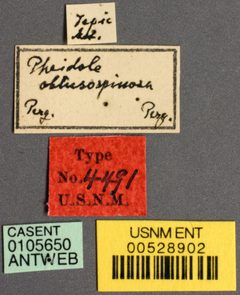
Pergande, 1896
Blunt-spined Big-headed Ant
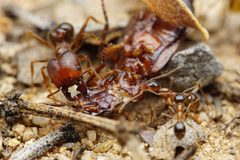
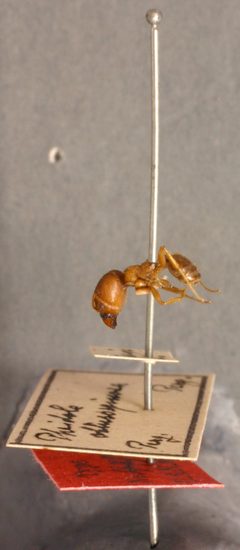
Pheidole obtusospinosa is a of big-headed in the Pheidole, characterized by soldier ants with enlarged, squared used for nest defense. The species belongs to the hyperdiverse ant genus Pheidole, which contains over 1,000 species globally. Soldiers of this species have been observed using their modified heads to block nest entrances against intruders, particularly army ants such as Eciton burchelli. The species was described by Pergande in 1896.
Pronunciation
How to pronounce Pheidole obtusospinosa: /faɪˈdoʊli ˌɒbtuːsoʊspaɪˈnoʊsə/
These audio files are automatically generated. While they are not always 100% accurate, they are a good starting point.
Identification
Soldier ants possess disproportionately large, squared with blunt spines (obtuse angles at the corners), from which the derives its name. The squared head shape distinguishes soldiers from other Pheidole species, which typically have more rounded head morphologies. Major (soldiers) use these heads to physically block nest entrances. Minor workers are smaller with proportionate heads. The species exhibits the characteristic dimorphic worker system of the Pheidole.
Images
Behavior
Soldier ants have been observed using their enlarged, squared to block nest entrances against intruders, particularly as a defense against army ants (Eciton burchelli). This phragmotic involves soldiers positioning themselves at nest openings to physically obstruct access by . The behavior represents a specialized defensive within the .
Similar Taxa
- Pheidole megacephalaAlso a big-headed with enlarged soldier , but P. megacephala soldiers have rounded rather than squared heads and lack the blunt spines characteristic of P. obtusospinosa
- Carebara phragmotica / C. lilithThese African also exhibit phragmotic with modified used to block nest entrances, but they belong to a different and have concave, saucer-shaped heads covered in debris rather than squared heads
Sources and further reading
- BugGuide
- Wikipedia
- GBIF taxonomy match
- iNaturalist taxon
- NCBI Taxonomy
- Catalogue of Life
- Big-headed Ants Are Biggest in Australia Due to Competition
- During Quarantine, an Entomologist Takes a Closer Look at a New Invasive Ant Species
- Fire ant winged reproductives: male and female | Beetles In The Bush
- Hymenoptera | Blog - Part 7
- Bichos Argentinos #2 – Pseudomyrmex sp. | Beetles In The Bush
- Ants in the Nest: A Possible Emerging Pressure on Sea Turtles