
Pheidole hyatti
Emery, 1895
Hyatt's Big-headed Ant
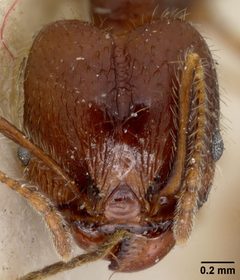
Pheidole hyatti is a of big-headed in the Formicidae. Native to the southwestern United States, Mexico, and Guatemala, it has become in Hawaii and possibly established in Panama, Bolivia, and Argentina. The species was described by Emery in 1895 and contains one accepted , Pheidole hyatti hyatti. As a member of the hyperdiverse Pheidole, it exhibits the characteristic with distinct major and minor worker .


Pronunciation
How to pronounce Pheidole hyatti: //faɪˈdoʊli ˈhaɪətaɪ//
These audio files are automatically generated. While they are not always 100% accurate, they are a good starting point.
Identification
Distinguishable from other Pheidole by morphological characters of the major and minor , though specific diagnostic features require expert examination. The species name honors Hyatt.
Images
Habitat
Native range includes arid and semi-arid regions of the southwestern United States and Mexico. in Hawaii occupy disturbed .
Distribution
Native: southwestern United States, Mexico, Guatemala. : Hawaii. Possibly present: Panama, Bolivia, Argentina.
Human Relevance
Recognized as an in Hawaii, where it has been introduced beyond its native range. Its spread by human activity follows the pattern of other tramp ant .
Similar Taxa
- Pheidole megacephalaBoth are big-headed ants with similar , but P. megacephala is a global supertramp with much broader invasive distribution
- Other Pheidole speciesOver 1,000 in share major/minor system; species-level identification requires examination of specific morphological characters
More Details
Taxonomic history
The was first described by Carlo Emery in 1895. A single , Pheidole hyatti hyatti, is currently recognized.
Sources and further reading
- BugGuide
- Wikipedia
- GBIF taxonomy match
- iNaturalist taxon
- NCBI Taxonomy
- Catalogue of Life
- Big-headed Ants Are Biggest in Australia Due to Competition
- During Quarantine, an Entomologist Takes a Closer Look at a New Invasive Ant Species
- Fire ant winged reproductives: male and female | Beetles In The Bush
- Hymenoptera | Blog - Part 7
- Bichos Argentinos #2 – Pseudomyrmex sp. | Beetles In The Bush
- Ants in the Nest: A Possible Emerging Pressure on Sea Turtles