
Eurhopalothrix
Brown & Kempf, 1961
Species Guides
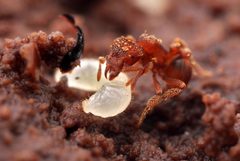
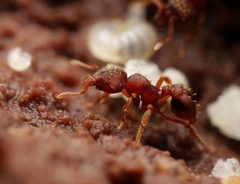
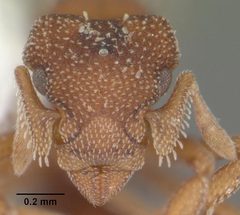
1Eurhopalothrix is a of small myrmicine ants in the tribe Attini. are characterized by distinctive shield-like facial structures with reduced and specialized mandibular . The genus occurs primarily in the Neotropics, with documented records from Central America through northern South America and into the Atlantic Forest of Brazil and temperate grasslands of Argentina. Several species have been described in recent taxonomic revisions, including 33 new species from Central America documented by Jack Longino.
Pronunciation
How to pronounce Eurhopalothrix: /ˌjuːrəʊˌpæloʊˈθrɪks/
These audio files are automatically generated. While they are not always 100% accurate, they are a good starting point.
Identification
Members of Eurhopalothrix possess a broad, shield-like that covers much of the , with reduced to small points positioned at the lateral margins. The are armed with multiple sharp teeth and often bear specialized setae. The capsule is typically triangular in shape. These features distinguish Eurhopalothrix from related basicerotine such as Rhopalothrix and Basiceros.
Images
Habitat
occur in forest floor leaf litter and rotting wood in tropical and subtropical forests. Eurhopalothrix bruchi has been recorded from grassland at 700 m elevation in mountain systems. Eurhopalothrix reichenspergeri is to the Brazilian Atlantic Forest.
Distribution
Neotropical distribution ranging from Central America through northern South America (Colombia) to the Brazilian Atlantic Forest and south to Buenos Aires Province, Argentina (38°03′41″ S, 61°59′18″ W).
Similar Taxa
- RhopalothrixRelated basicerotine ; Eurhopalothrix was separated from Rhopalothrix based on mandibular and clypeal structure
- BasicerosAnother basicerotine with convergent mandibular specializations; differs in capsule shape and setal patterns
Sources and further reading
- BugGuide
- Wikipedia
- GBIF taxonomy match
- iNaturalist taxon
- NCBI Taxonomy
- Catalogue of Life
- 'The Astonishing Ant Man' Jack Longino to Speak at UC Davis | Bug Squad
- 33 Scary New Ant Species Discovered in Central America
- Geographic Distribution of Eurhopalothrix floridana (Hymenoptera: Formicidae)
- Redescription of Eurhopalothrix reichenspergeri (Santschi, 1923) stat. rev. (Hymenoptera: Formicidae), a Brazilian Atlantic Forest endemic species
- Southernmost record and new habitat type for Eurhopalothrix bruchi (Santschi, 1922) (Hymenoptera: Formicidae) in Sierra de La Ventana (Buenos Aires, Argentina)
- A New Species of Small Myrmicine Ant in the Genus Eurhopalothrix Brown & Kempf, 1961 (Hymenoptera: Formicidae) From Colombia