
Polyergus
Latreille, 1804
Amazon ants, slave-raiding ants, slave-making ants
Species Guides
9- Polyergus bicolor(Bicolored Amazon Ant)
- Polyergus breviceps(Broad-headed Amazon Ant)
- Polyergus longicornis(Long-horned Amazon Ant)
- Polyergus lucidus(Shining Slave-Making Ant)
- Polyergus mexicanus(Western Amazon Ant)
- Polyergus montivagus(Foothills Amazon Ant)
- Polyergus sanwaldi(Sanwald's Amazon Ant)
- Polyergus topoffi(Topoff's Amazon Ant)
- Polyergus vinosus(Wine-red Amazon Ant)
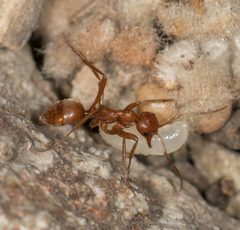
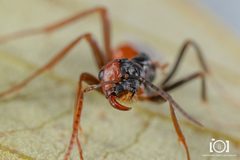
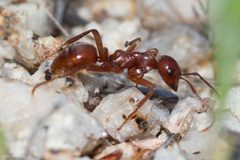
Polyergus is a of 14 described of obligate slave-making ants found throughout the northern hemisphere. possess highly specialized dagger-like adapted for piercing the of ants during raids, but have lost the ability to perform care or feed themselves. All colonies depend entirely on captured workers from the genus Formica to perform nest maintenance, foraging, and brood rearing. New colonies are founded when a single invades an existing Formica nest, eventually killing the host queen and assuming control of the worker force.
Pronunciation
How to pronounce Polyergus: /pɒliˈɜːɡəs/
These audio files are automatically generated. While they are not always 100% accurate, they are a good starting point.
Identification
Polyergus are distinguished by their sickle-shaped, piercing —elongate and sharply pointed unlike the chewing mandibles of most ants. Workers have a sleek, shiny with reduced pilosity. identification requires examination of leg coloration, , and body proportions; the three species groups (lucidus, rufescens, samurai) differ in coloration from reddish to blackish. Workers are typically larger than their Formica and move with a distinctive rapid, erratic gait during raids.
Images
Habitat
Colonies occupy pre-existing subterranean nests of their Formica , primarily in open grasslands, meadows, forest edges, and disturbed . The shows broad habitat across its range, from eastern deciduous forests to western montane regions and high desert environments. Specific habitat associations vary by ; for example, P. montivagus occurs in foothill grasslands while P. vinosus inhabits coastal sage scrub and chaparral.
Distribution
Holarctic distribution with 11 Nearctic and 3 Palaearctic . The rufescens group occurs across western Eurasia (P. rufescens) and western North America from the Great Plains to the Pacific coast. The lucidus group is restricted to eastern and central North America. The samurai group comprises two blackish species: P. samurai in Japan, Korea, and eastern China, and P. nigerrimus in Mongolia and southern Russia.
Seasonality
Raiding activity is strongly seasonal and , occurring primarily in late afternoon and early evening during summer months. In temperate regions, raids typically span a 6–8 week period annually. Colony foundation occurs in late summer when winged queens disperse; sexual have been observed in July and August in North American .
Host Associations
- Formica - obligate All depend on captured Formica for colony maintenance; specificity varies by Polyergus species and region. P. rufescens primarily uses Formica fusca group species; P. lucidus group species associate with F. pallidefulva and related species; P. breviceps uses F. fusca group hosts in western North America.
Life Cycle
Colonies are , persisting 10–15 years. New colonies are founded by haplometrosis: a single dealate invades an existing Formica nest or associates with a founding queen and her first . The Polyergus queen kills the host queen once sufficient workers are present to support her. The host workers then rear all subsequent Polyergus . Mature colonies contain 300–1000+ Polyergus workers and hundreds to thousands of Formica slaves. Ergatoids (large worker-like reproductive females) occur in some colonies and may function as replacement reproductives.
Behavior
are incapable of care, nest construction, or self-feeding due to evolutionary degeneration of these . They function exclusively as raiders, conducting organized slave raids on Formica colonies to replenish the worker force. Raids involve chemical recruitment, column formation, and direct combat using to pierce worker . Scouts locate target colonies and recruit nestmates; raiding columns may travel tens of meters. Workers also exhibit digging behavior to breach host nest entrances. Queens have been observed following outbound raiding columns during sexual .
Ecological Role
As an obligate social , Polyergus represents an extreme form of interspecific exploitation that structures dynamics. Raids can significantly impact local Formica . Non- ant including Myrmica and Lasius have been observed scavenging on raid casualties, indicating indirect facilitation of carrion availability. The serves as a model system for studying the evolution of behavioral specialization and social .
Human Relevance
Polyergus colonies are rarely encountered due to their dependence on established and relatively low colony . The is of scientific interest for studies of social evolution, behavioral , and structure. No direct economic impacts have been documented; colonies do not invade human structures.
Similar Taxa
- Formica sanguinea groupFacultative slave-makers in the same tribe; possess functional for care and can exist without slaves, unlike obligate Polyergus
- Temnothorax pilagensAnother slave-making with reduced raiding party size and chemical camouflage, but differs in minute size (2.5 mm), acorn-nest , and stinger-based killing rather than mandibular piercing
- RossomyrmexOld World slave-making ants with convergent behavioral but distinct and associations
Sources and further reading
- BugGuide
- Wikipedia
- GBIF taxonomy match
- iNaturalist taxon
- NCBI Taxonomy
- Catalogue of Life
- Bug Eric: Raid of the Slave-makers
- Predator or Prey? | Beetles In The Bush
- Ants invade Beetles in the Bush! | Beetles In The Bush
- Pensoft Editorial Team | Blog - Part 131
- Uncategorized | Blog - Part 27
- Known Distribution of the Shining Slave Maker Ant Polyergus lucidus Mayr
- Hyenism in Ants: Non-Target Ants Profit From Polyergus rufescens Raids (Hymenoptera: Formicidae)
- Global revision of the dulotic ant genus Polyergus (Hymenoptera: Formicidae, Formicinae, Formicini)
- Regulation of Host Workers' Oviposition by the Social Parasite AntPolyergus samurai
- Host nest usurpation and colony foundation in the European amazon ant,Polyergus rufescens Latr. (Hymenoptera: Formicidae)
- Host colony usurpation by the queen of the Japanese pirate ant, Polyergus samurai (hymenoptera: formicidae)
- Modeling the aggregative behavior of ants of the species Polyergus rufescens
- Eco‐ethological Study on Raiding Behaviour of the European Amazon Ant, Polyergus rufescens Latr. (Hymenoptera: Formicidae)
- Mating and post‐mating behaviour of the European amazon ant,Polyergus rufescens(Hymenoptera, Formicidae)
- Behavioral Ecology of the Slave-Making Ant, Polyergus breviceps, in a Desert Habitat
- Colony takeover by a socially parasitic ant, Polyergus breviceps: the role of chemicals obtained during host-queen killing
- Ecology of Raiding Behavior in the Western Slave-Making Ant Polyergus breviceps (Formicidae)
- Behavioural and socially parasitic relations between <i>Polyergus rufescens</i> (Latr.) and Formica polyctena Först. (Hymenoptera: Formicidae)
- The evolution of slave-making behavior in the parasitic ant genusPolyergus
- Social and orientation behavior of Polyergus breviceps during slave-making raids
- Reference genome of the kidnapper ant, Polyergus mexicanus.