
Camponotus novogranadensis
Mayr, 1870
Black Compact Carpenter Ant
Camponotus novogranadensis is a of carpenter ant in the subgenus Myrmobrachys, known from South America. It is one of over 1,000 species in the Camponotus. The species has been documented in Colombia and across much of Brazil, with records from diverse including tropical forests and disturbed areas. As a member of the compact carpenter ant group, it shares morphological traits with related species such as the Camponotus planatus.
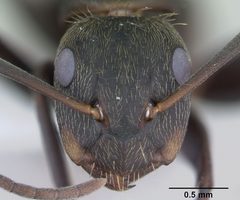
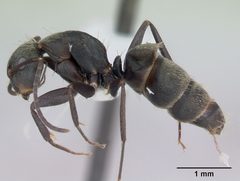
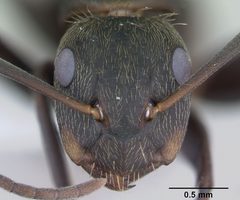
Pronunciation
How to pronounce Camponotus novogranadensis: /ˌkæmpəˈnoʊtəs ˌnoʊvoʊˌɡræɪnəˈdɛnsɪs/
These audio files are automatically generated. While they are not always 100% accurate, they are a good starting point.
Images
Distribution
Documented from Colombia (Valle del Cauca, including Distrito Regional de Manejo Integrado Laguna de Sonso near Guadalajara de Buga) and extensively across Brazil, with records from states including Acre, Alagoas, Amazonas, Amapá, Bahia, Distrito Federal, Espírito Santo, Goiás, Maranhão, Minas Gerais, Mato Grosso do Sul, Mato Grosso, Pará, Paraná, Rio de Janeiro, Rondônia, Roraima, Rio Grande do Sul, Santa Catarina, Sergipe, São Paulo, and Tocantins. Also recorded from Montería and Villavicencio in Colombia.
Similar Taxa
- Camponotus planatusBoth belong to subgenus Myrmobrachys and share the characteristic low, broad mesosoma and tucked- posture when . C. planatus has become in Florida and Texas, while C. novogranadensis appears to remain restricted to South America.
- Camponotus musAnother South American Myrmobrachys with similar overall gestalt—black coloration, bulbous , and velvety pilosity. C. mus is abundant in Argentina and shares the distinctive habit of with tucked under the body.
More Details
Taxonomic placement
The belongs to subgenus Myrmobrachys, a diverse group within Camponotus characterized by relatively low and broad mesosoma .
Sources and further reading
- BugGuide
- GBIF taxonomy match
- iNaturalist taxon
- NCBI Taxonomy
- Carpenter ants here and there: Camponotus spp. — Bug of the Week
- Ant bodyguards here and there: Odorous house ants, Tapinoma sessile, and carpenter ants, Camponotus — Bug of the Week
- Big black ants in the home: Carpenter ants, Camponotus spp. — Bug of the Week
- Formicidae | Beetles In The Bush | Page 2
- Bichos Argentinos #10 – Friday Formicine | Beetles In The Bush
- Amped-Up Ants: Caterpillars' Sugary Treats Earn Carpenter Ant Care