
Camponotus americanus
Buckley, 1866
American Carpenter Ant
Camponotus americanus is a North American carpenter ant characterized by its relatively large size among . measure 7–10 mm in length. The species is primarily ground-nesting, though it exhibits flexibility in nest site selection. It belongs to the diverse Camponotus, which contains over 1,000 species globally and is notable for its wood-excavating habits and ecological roles as decomposers.
Pronunciation
How to pronounce Camponotus americanus: /ˌkæmpəˈnoʊtəs əˌmɛrɪˈkeɪnəs/
These audio files are automatically generated. While they are not always 100% accurate, they are a good starting point.
Identification
can be distinguished from other Camponotus by their 7–10 mm body length and primarily ground-nesting , contrasting with many that nest exclusively in wood. The species may be confused with other black or dark-colored carpenter ants; precise identification likely requires examination of specific morphological characters not detailed in available sources. Distinguishing from Camponotus pennsylvanicus and other large North American carpenter ants may require expert examination.
Images
Appearance
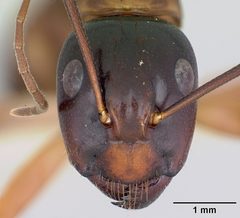
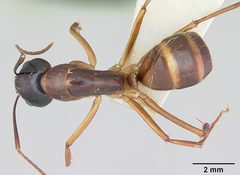
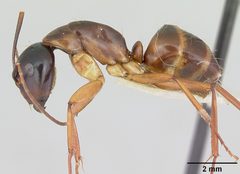
are 7–10 mm in length, placing them above average in size compared to many . The species exhibits the typical carpenter ant : robust body with a single-node petiole, and a rounded, often bulbous . Coloration details are not explicitly documented in available sources.
Habitat
Primarily nests in soil. Also documented nesting under stones, under litter, and in rotten logs. The shows flexibility in nest site selection compared to many carpenter ants that are strictly arboreal or wood-nesting.
Distribution
North America. Specific distribution records include Vermont, USA. The is presumably more broadly distributed across eastern or central North America, though precise range boundaries are not established in available sources.
Similar Taxa
- Camponotus pennsylvanicusBoth are large North American carpenter ants with dark coloration. C. pennsylvanicus is strictly associated with wood nesting and is a significant structural pest, whereas C. americanus is primarily ground-nesting with more flexible site selection.
- Camponotus musBoth share the bulbous and general carpenter ant , but C. mus is a South American with distinctive velvety yellowish abdominal pilosity and is placed in subgenus Myrmobrachys with characteristic low, broad mesosoma and tucked-gaster posture.
More Details
Taxonomic Authority
Sources conflict on authorship: GBIF indicates Buckley, 1866, while NCBI indicates Mayr, 1862. This discrepancy may reflect historical taxonomic revisions or synonymy issues requiring further verification.
Sources and further reading
- BugGuide
- Wikipedia
- GBIF taxonomy match
- iNaturalist taxon
- NCBI Taxonomy
- Formicidae | Beetles In The Bush | Page 2
- Carpenter ants here and there: Camponotus spp. — Bug of the Week
- Ant bodyguards here and there: Odorous house ants, Tapinoma sessile, and carpenter ants, Camponotus — Bug of the Week
- Bichos Argentinos #10 – Friday Formicine | Beetles In The Bush