
Xanthoteras teres
Weld, 1926
Ball-tipped Gall Wasp
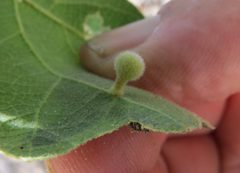
Xanthoteras teres is a cynipid gall wasp native to western North America. The induces distinctive galls on oak leaves, characterized by an upright stalk topped with a fuzzy spherical structure. Formerly classified under the Trigonapsis, it was reclassified to Xanthoteras based on taxonomic revision. The has been documented primarily in Oregon and California.
Pronunciation
How to pronounce Xanthoteras teres: //zænˈθoʊtərəs ˈtɛriːz//
These audio files are automatically generated. While they are not always 100% accurate, they are a good starting point.
Identification
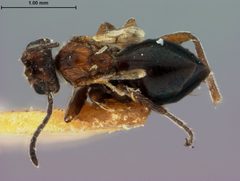
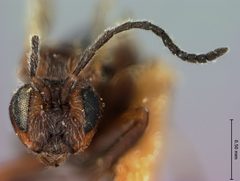
The gall induced by Xanthoteras teres is diagnostic: an upright, slender stalk rising from the leaf surface, terminating in a fuzzy, ball-shaped tip. This 'Suessian' distinguishes it from other cynipid galls on oaks in the same geographic range. The itself is small and typical of cynipid morphology, but identification relies primarily on gall characteristics.
Images
Habitat
Associated with oak woodlands and savannas where oaks occur. Found in supporting Oregon oak (Quercus garryana) and leather oak (Quercus durata).
Distribution
Oregon and California, western North America.
Host Associations
- Quercus garryana - Oregon oak; leaves are oviposition site
- Quercus durata - Leather oak; leaves are oviposition site
Behavior
Females oviposit on oak leaves, inducing gall formation. The resulting gall structure consists of an upright stalk with a terminal fuzzy ball.
Ecological Role
As a gall inducer, the manipulates oak tissue to form a protective structure for larval development. The galls represent a form of plant-insect interaction that creates novel microhabitats on leaf surfaces.
Human Relevance
No direct economic or agricultural significance has been documented. The distinctive galls may be encountered by field biologists, naturalists, and oak taxonomists.
Similar Taxa
- Other Cynipidae on QuercusOther cynipid induce galls on oaks, but X. teres is distinguished by its unique ball-tipped stalk . Linear, spherical, or irregularly lobed galls without this stalked structure are induced by different .
More Details
Taxonomic History
Originally described as Trigonapsis teres by Lewis Hart Weld in 1926. Subsequently transferred to the Xanthoteras, though the specific epithet teres was retained.
Sources and further reading
- BugGuide
- Wikipedia
- iNaturalist taxon
- Public Service Project Targeting Coronavirus Pandemic | Bug Squad
- Waxing Poetic About Honey Bees and This Amazing UC Davis Bee Class on Wax Working | Bug Squad
- Ria de Grassi Wins the Bumble Bee Contest! | Bug Squad
- Edible Plant Oils Show Potential for Management of Aedes aegypti
- Bug Eric: Spider Sunday: Homalonychus
- Macaronesia | Blog