
Heteroecus sanctaeclarae
(Fullaway, 1911)
Mushroom Gall Wasp, Steeple Gall Wasp
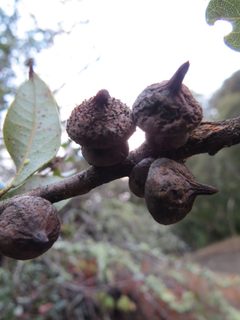
Heteroecus sanctaeclarae is a cynipid gall wasp that induces distinctive bud galls on oaks. The galls are bilobed, with the larval chamber located at the seam between the two sections. This was first described by David T. Fullaway in 1911 under the name Callirhytis sanctae-clarae. It is primarily known from the Pacific coast of North America.


Pronunciation
How to pronounce Heteroecus sanctaeclarae: /ˌhɛtəˈroʊiːkəs ˌsæŋkteɪˈklɑreɪ/
These audio files are automatically generated. While they are not always 100% accurate, they are a good starting point.
Identification
Identified by the distinctive mushroom-shaped or steeple-shaped bud galls it induces on oaks. The galls are bilobed with a visible seam; the upper section resembles a rounded cap or dome, while the lower section forms the base. Gall coloration is variable, including beige, grey, pink, purple, and white. The larval chamber is positioned at the junction between the two gall sections. require examination for -level identification.
Images
Habitat
Associated with oak woodlands and chaparral containing huckleberry oak (Quercus vacciniifolia) and canyon live oak (Quercus chrysolepis).
Distribution
Pacific coast of North America.
Host Associations
- Quercus vacciniifolia - induces gallshuckleberry oak
- Quercus chrysolepis - induces gallscanyon live oak
Life Cycle
Develops within bud galls on oaks. The larval chamber is located at the seam between the two sections of the bilobed gall.
Ecological Role
Acts as a gall inducer, manipulating oak tissue to form protective structures for larval development. The galls represent a form of plant-animal interaction that creates specialized microhabitats.
Similar Taxa
- Other Heteroecus speciesSame members also induce galls on oaks; identification requires examination of gall and characteristics.
- Other Cynipidae on QuercusNumerous cynipid induce galls on oaks; mushroom-shaped galls are distinctive to this but may be confused with other bilobed gall forms without close inspection.
More Details
Gall morphology
The 'mushroom gall wasp' and 'steeple gall wasp' derive from the gall's appearance: the upper lobe resembles a toadstool cap or an onion dome, while the overall structure has been likened to a woodland cottage in children's book illustrations.
Taxonomic history
Originally described as Callirhytis sanctae-clarae by Fullaway in 1911; later transferred to Heteroecus. The basionym Callirhytis sanctaeclarae remains in synonymy.