
Feron parmula
(Bassett, 1900)
Disc Gall Wasp
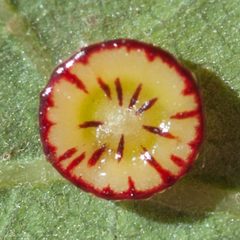
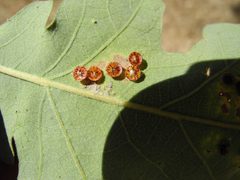
Feron parmula, the disc gall wasp, is a cynipid that induces distinctive disc-shaped galls on oak , particularly white oaks and their hybrids. The galls are small, pale structures with red streaking, reaching up to 3 mm in diameter. females emerge in April. The species has been documented on the Pacific coast of North America.
Pronunciation
How to pronounce Feron parmula: /ˈfɛr.ən pɑːrˈmuː.lə/
These audio files are automatically generated. While they are not always 100% accurate, they are a good starting point.
Identification
Disc-shaped galls with pale coloration and red streaking, up to 3 mm diameter, on oak leaves and twigs. Distinguished from similar by gall and association: Feron gigas produces larger galls, Andricus viscidus has viscid (sticky) galls, and two recently identified (informally called "plate gall wasp" and "orange-cap gall wasp") differ in gall structure and coloration.
Images
Appearance
are small cynipids typical of the . The galls induced by this are disc-shaped, up to 3 mm in diameter, pale in color with red streaking.
Habitat
Oak-dominated , particularly those containing white oaks (Quercus sect. Quercus) and their hybrids.
Distribution
Documented on the Pacific coast of North America, specifically in Oregon and California.
Seasonality
females emerge in April.
Host Associations
- Quercus - gall inducerwide selection of oak , especially white oaks and including hybrids
Behavior
Induces gall formation on oak tissue. The specific mechanism and whether the is unisexual or sexual (alternating ) is not documented in available sources.
Ecological Role
As a gall inducer, modifies oak plant tissue, creating specialized microhabitats that may support and within the gall .
Similar Taxa
- Feron gigasProduces superficially similar galls, but F. gigas galls are larger in size
- Andricus viscidusProduces superficially similar galls, but distinguished by viscid (sticky) gall surface
- "plate gall wasp"Newly identified with superficially similar galls, distinguished by gall structure (informal name used by Ronald Russo)
- "orange-cap gall wasp"Newly identified with superficially similar galls, distinguished by coloration (informal name used by Ronald Russo)