
Cynips mirabilis
Speckled Gall Wasp
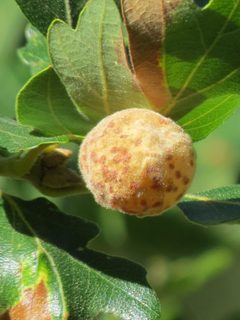
Cynips mirabilis, commonly known as the speckled gall wasp, is a cynipid native to western North America. The induces distinctive galls on Oregon oak (Quercus garryana) leaves, with larvae developing inside detachable, speckled galls. It exhibits a complex involving multiple , a common trait among Cynipidae. The species was formerly placed in the Besbicus but has been reclassified under Cynips. It is one of the most frequently observed gall wasps in its range, with over 2,000 documented observations.
Pronunciation
How to pronounce Cynips mirabilis: /ˈsɪnɪps mɪˈræbɪlɪs/
These audio files are automatically generated. While they are not always 100% accurate, they are a good starting point.
Identification
Most easily identified by the galls it produces on Oregon oak leaves. Galls occur primarily on the underside midrib (rarely ), are detachable, speckled in appearance, and contain 1–3 galls per leaf. The internal structure—central larval chamber with radiating fiber connections to the husk—is diagnostic. require examination for reliable identification.
Images
Habitat
Associated with Oregon oak (Quercus garryana) woodlands and savannas. Galls form on living oak leaves. The requires intact oak with suitable leaf tissue for gall induction.
Distribution
Western North America, centered on the range of Oregon oak. Documented from California northward through Oregon and Washington, with records extending into British Columbia.
Seasonality
Activity tied to oak leaf . Gall formation visible when oak leaves are present; and oviposition occur during periods of active leaf growth. Multiple per year suggested by structure.
Host Associations
- Quercus garryana - Oviposition and gall formation on leaf midribs; primary and likely obligate .
Life Cycle
Complex with multiple , typical of Cynipidae. Females oviposit on Oregon oak leaf midribs, inducing gall formation. Larvae develop within detachable galls, with the larval chamber centrally positioned and connected to the husk by radiating fibers. Second generation has been documented; full not completely described in available sources.
Behavior
Females oviposit selectively on the underside midrib of oak leaves. Gall induction manipulates plant tissue to create a protected larval chamber. No observations of social or mating systems documented.
Ecological Role
Acts as a gall inducer on Oregon oak, creating structures that may be used by other organisms. As a herbivore, it contributes to oak leaf damage and nutrient cycling. Potential food source for gall-inhabiting and , though specific associates not documented.
Human Relevance
Of interest to naturalists and entomologists studying gall wasp diversity and oak . The readily observable galls make it a useful subject for citizen science and educational observation. No economic importance to agriculture or forestry documented; not considered a significant pest.
Similar Taxa
- Other Cynips speciesMultiple Cynips induce galls on oaks; accurate identification requires examination of gall , species, and location on plant. C. mirabilis is distinguished by the speckled, detachable galls on Oregon oak midribs with characteristic internal fiber structure.
- Besbicus speciesFormerly classified in this ; taxonomic reclassification means some literature may use outdated . Current places C. mirabilis in Cynips.
More Details
Taxonomic history
The was long known as Besbicus mirabilis before reclassification to Cynips mirabilis. This change reflects ongoing revision of cynipid based on molecular and morphological data.
Observation frequency
With over 2,000 iNaturalist observations, this is among the most frequently documented gall wasps in western North America, likely due to the conspicuous and accessible nature of its galls.
Gall structure
The radiating fiber connections between larval chamber and husk represent a distinctive architectural feature among oak galls, potentially aiding in or structural support.